
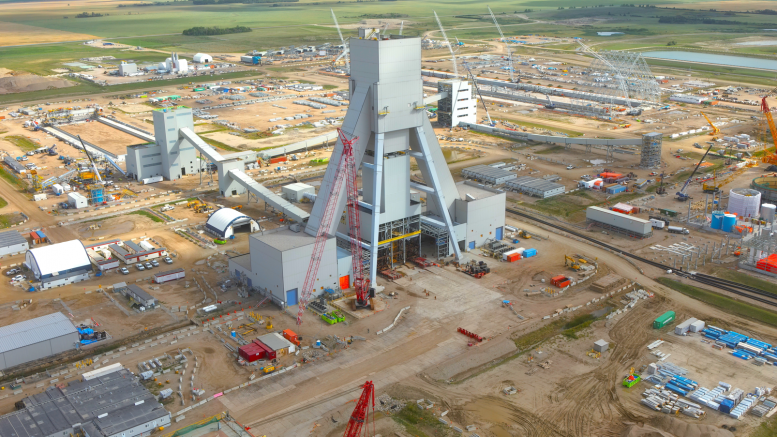
BHP’s (NYSE, LSE, ASX: BHP) Jansen mine in Saskatchewan – at $15.3 billion (C$21.6 billion), the company’s biggest ever investment – will join a packed field when it enters production about a year from now.
Output of 12.6 million tons (11.4 million tonnes) from new potash mines in countries including Canada, Russia and newcomer Laos is set to start by 2030, putting pressure on global prices, according to London-based commodities and minerals market intelligence consultancy CRU. That works out to an estimated 8% increase from 2025 output.
“From 2027 onwards, there’s going to be a lot of excess capacity being added,” Alexander Chreky, fertilizer analyst and potash specialist at CRU in London, told The Northern Miner in an interview.
“When you add so much supply to the market, even if you have an increase in demand, there is going to have to be a price response of some sort. The potash industry is kind of a chronically oversupplied industry, so when you’re adding supply, that’s going to mean that prices are pushed down.”
Located about 140 km east of Saskatoon, Jansen is crucial to BHP’s ambitions of building a significant footprint in potash – a new commodity for the mining behemoth. The investment, the largest in Saskatchewan’s history, is part of an effort by BHP to shift its portfolio away from steelmaking materials and towards what executives call “future-facing commodities” such as copper and potash.
“When a new player comes into any market in any commodity, there’s always some placement and positioning,” Allan Pickett, head of fertilizer analysis at S&P Global Commodity Insights in London, said in an interview. “People compete, so the initial reaction is likely to be that prices at the time will be slightly less strong than they otherwise might have been.”
Top-tier producer
BHP is aiming to start producing potash at Jansen in mid-2027, six months later than previously expected. Over time, Jansen is expected to become one of the world’s largest potash mines, producing about 8.5 million tonnes of the fertilizer annually – equivalent to about 10% of current global supply.
Developing Jansen won’t come cheap. A detailed review of cost and schedule estimates for the mine’s first stage, completed in January, led BHP to add $1 billion to its previous forecast. That boosted the overall construction budget to $8.4 billion.
On June 18, BHP blamed additional construction hours and materials as it boosted the total investment estimate for Jansen’s second stage to $6.9 billion, including contingencies – a 41% jump. The cost update, the result of a detailed review, will force BHP to take an impairment charge of $2.3 billion when it releases annual results July 16.
“Once ramped up, Jansen will be a world-class, low-cost potash producer” similar to BHP’s Western Australia iron ore operations, outgoing CEO Mike Henry told financial analysts Feb. 17.
“It will also make BHP stronger because potash demand drivers and key customer markets are differentiated from our other commodities, meaning even lower volatility in earnings and cash flow generation.”
Each stage of Jansen is expected to deliver earnings before interest, taxes, depreciation and amortization of around $1 billion per year, with margins topping 60%, Henry added.
Elsewhere in Canada
Jansen isn’t the only new potash mine being planned in Canada. German miner K+S has begun work on a planned $4.1-billion expansion of its Bethune operation in Saskatchewan. A first stage of construction is expected to be completed by 2030 as part of a broader plan to double annual output to 4 million tonnes by 2040.
K+S and BHP join global rivals such as Russia’s Urakali and Switzerland-based EuroChem Group in planning capacity additions, Chreky said. Combined, Russian producers could potentially add about 5 million tonnes a year of new output by 2030, he said.
“BHP might be the single largest addition to the market, but actually more capacity is coming online in Russia,” Chreky said.
Canada was the world’s biggest potash producer in 2024, churning out about one-third of global output. Combined, Russia and Belarus accounted for about 38% of supply, Natural Resources Canada data show.
Potash demand is projected to grow by about 70% by 2050, “with very low substitution risk,” Henry said on a February conference call.
BHP expects Jansen’s volumes to be absorbed “without structural disruption,” supported by a “gradual market entry aimed at limiting any pricing impact,” BMO Capital Markets mining analyst Alexander Pearce said in a May 14 note.
Potash resurgence
Jansen’s arrival comes with the appetite for potash enjoying a resurgence of sorts. Annual demand has grown by about 1 million tonnes per year since 2024, CRU data show.
Long-term demand for potash typically rises by 1.5% to 2% a year, according to S&P Global’s Pickett. Population growth and wealth are the two main drivers of fertilizer demand, he said.
Potash is the least applied of the three major types of fertilizers, industry data show. Nitrogen is the most popular, followed by phosphates.
Appetite for potash is underpinned by United Nations forecasts showing the global population will continue growing until the 2070s. And as countries get richer, their potash demand increases.
“Potash is a bet on increasing populations, but not only that, on populations getting richer,” Chreky said.
Following a dip to about $270 per tonne in late 2024, potash was trading at about $405 a tonne on the spot market as press time neared. Prices are still well below their historical 2022 peak of over $1,200 per tonne – a direct result of Russia’s war on Ukraine, which froze Russian potash out of global markets.
Price outlook
As new mines around the globe enter production, potash prices could start falling as soon as the end of 2027, Chreky said. He declined to provide an estimate for the magnitude of the drop, citing proprietary data.
“There will be definitely a price response,” he said. “The degree really depends on the behavior of the new entrants. We’re not exactly sure how BHP is going to behave, but they’re adding a lot of capacity to the market, around a little over 4 million tonnes, and that’s just stage one.”
To be sure, even if potash prices do fall, they’re unlikely to enter a multiyear slump comparable to what nickel went through when Chinese producers added new facilities in Indonesia and elsewhere, Chreky said.
“It’s not going to be apocalyptic,” he said. “Nobody’s going to go out of business.”
As Jansen starts operations, BHP may try to use its financial clout to develop new markets in regions such as Africa, analysts say.
“Africa would be an exceptionally good example where not much potash is used, and not much fertilizer is used,” Pickett said.
BHP “could get into new markets that other people haven’t had the ability to target because they have so much money that they can develop the African market, for example, which really lags in terms of potash demand,” Chreky said.
Jansen’s cost almost ensures that the second stage will eventually get built.
“Phase 2 is going to happen for sure. It has to happen because that’s the only way that the BHP Phase 1 really makes sense,” Chreky said. “They sank such a huge shaft that it would just be overwhelming the first stage. So it’s just a question of when it happens, rather than if it happens.”
Be the first to comment on "BHP’s Jansen mine, a year away, faces crowded slot"