
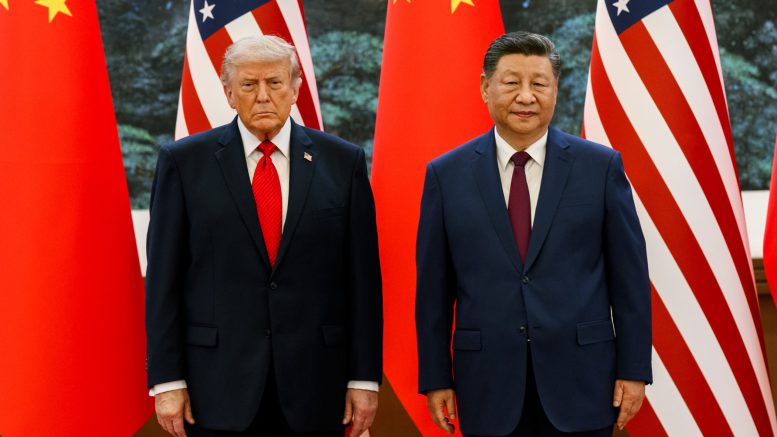
China’s stranglehold on the global rare earths supply is expected to “stay firmly in place” despite the recent summit between its President Xi Jinping and his United States counterpart Donald Trump, according to Fitch Group’s BMI.
In his first visit for nearly a decade, Trump travelled to Beijing May 14-15 to address various global security and trade concerns. Amongst the most closely watched topics were rare earths, for which China controls about 60% of the world’s mined output and nearly all of the minerals’ processing capacity.
Last year, the Asian nation leveraged its near-monopoly position on the rare earth market to combat U.S. tariffs, imposing export restrictions in two successive waves. It first tightened exports on seven rare earth elements, related compounds and magnets, before broadening its reach to encompass five other elements and widening licensing requirements to cover products made with Chinese-sourced materials or technologies.
While Beijing later agreed to suspend the latter measures in late October, that was for just one year, and the broader controls are expected to resume in November.
In the lead-up to and during the Trump-Xi summit, market observers were monitoring whether that one-year suspension would get extended, and if talks could even result in an outright rare earth accord between the two sides.
While Trump had called his Beijing trip a “success”, no formal agreements or trade truce extensions have been announced. The White House has only reported that Beijing had committed “to addressing U.S. concerns over supply shortages of rare earths,” without giving much detail.
Reducing Chinese dependence
According to analysts at BMI, that uncertainty is still expected to linger, and Beijing’s chokehold on U.S. mineral supplies is not expected to disappear. Much of the U.S.’s mineral imports still come from China, according to the U.S. Geological Survey.
Even with the one-year respite, supplies of some minerals — the so-called “heavy” rare earths — remain hard to source, according to customs data. Overall shipments of export-controlled rare earths have remained well below historical levels, with exports of yttrium, dysprosium and terbium running at just 42%, 41% and 49% of volumes recorded in the 12 months preceding the restrictions, BMI noted.
One element that has seen an acute shortage is yttrium, whose price has risen 15-fold since the Chinese export controls. Slower shipments of the mineral, used as a thermal barrier coating on turbine blades and as a protective coating and insulator in semiconductor applications, have prompted widespread alarm across the U.S. aerospace and semiconductor industries.

In an attempt to reduce its dependence on China, the U.S. government has stepped up its efforts over the past year to build a resilient mine-to-magnet supply chain, accelerating domestic industrial policy while deepening international cooperation.
Domestic initiatives across the entire supply chain range include a landmark $400 million investment into MP Materials (NYSE: MP), the only rare earth miner in the country, and a $1.6 billion funding for USA Rare Earth (NASDAQ: USAR), which is developing a large deposit in Texas and as well as building out processing capacity.
On the international front, coordinated government efforts to secure reliable rare earth supplies are also being mobilized towards select projects and partnerships across Australia, Canada, Greenland, Angola, Mozambique, Brazil and Saudi Arabia, BMI noted.




Be the first to comment on "China’s rare earths lead seen lasting post-summit: BMI"