
South Africa’s Gold Fields (JSE, NYSE: GFI) reaffirmed its 2026 production and cost guidance on Thursday, but warned that surging energy prices tied to the Iran war are pushing up fuel, freight and explosives costs across its global operations.
Although diesel prices have risen between 30% and 70% since February and liquefied natural gas prices have climbed about 30%, increasing pressure on operating costs, the gold miner still expects to produce between 2.4 million and 2.6 million oz. of the metal in 2026. Freight costs have risen 40%, while explosives and cyanide prices are both about 10% higher.
Assuming oil at $100 per barrel, the impact could add $40 to $50 per oz. across the company’s portfolio, Gold Fields said. Fuel-efficient haulage systems and other operational measures should help offset the increases and allow the company to maintain full-year cost guidance.
Cost management was “in focus amidst inflationary headwinds,” BMO Capital Markets mining analyst Raj Ray said Thursday in a note. Although Gold Fields faces “incremental cost risk” stemming from the Iran conflict, “confidence remains in delivering within guidance ranges,” he added.
The warning highlights how renewed geopolitical tensions are rippling through the mining sector as producers grapple with volatile fuel markets and higher input costs. While bullion prices remain historically elevated, miners face growing pressure from inflation across energy-intensive operations, particularly at remote sites dependent on diesel and liquefied natural gas.
International crude prices surged after United States and Israeli airstrikes on Iran triggered fears of broader supply disruptions, with Brent crude briefly reaching about $126 per barrel in late April before retreating below $100 this week.
Gold prices, which hit a record near $5,595 an oz. in January, have since pulled back to around $4,750 an ounce.
Chile mine carries output
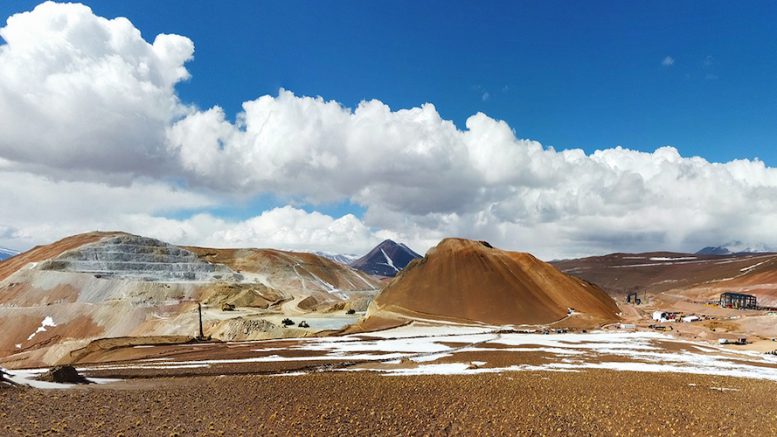
Gold Fields produced 633,000 oz. of gold in the first quarter, up 15% from a year earlier, as higher output from its Salares Norte mine in Chile offset weaker production at Tarkwa in Ghana and the Agnew and Gruyere mines in Australia.
“Gold Fields delivered a steady first quarter operationally, (…) underpinned by strong delivery from Salares Norte but offset by operational challenges at Gruyere, Agnew, and Tarkwa,” Ray said. Salares Norte was “the key driver,” he added.
Salares Norte delivered 173,000 gold-equivalent oz. during the quarter, up 245% year-over-year and 8% from the previous quarter, helped by stronger throughput and improved gold and silver recoveries. The operation’s strong second-half performance in 2025 carried into its first full year of commercial production, the company said.
Gold Fields also confirmed that the Damang mine was transferred to the Ghanaian government in April, following the expiry of its mining lease. The company said the handover was completed safely while maintaining operational stability.
The miner separately disclosed notices of dispute from contractor Engineers and Planners (E&P) over historical claims tied to mining contracts at Tarkwa and Damang. The disputes are now heading to arbitration.
“We are committed to resolving these matters in an orderly manner, while maintaining operational stability at Tarkwa,” the company said.
Reshaping portfolio
Gold Fields has accelerated acquisitions and mine investments as it looks to improve asset quality and extend production lives across its portfolio.
It acquired Osisko Mining in 2024 for $1.58 billion and bought Gold Road Resources in 2025 for $2.6 billion as part of its broader expansion strategy.
Over the next five years, Gold Fields plans to invest in materials handling upgrades at St Ives and Granny Smith, pre-stripping work at Salares Norte, development at South Deep and renewable energy projects aimed at lowering long-term power costs.

Be the first to comment on "Gold Fields flags oil shock as mining costs climb"