
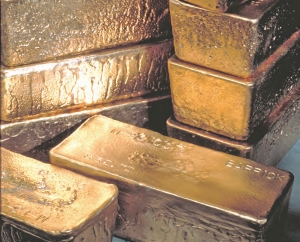
As the price of gold surpassed the critical US$1,000 per oz. mark on Sept. 8, Barrick Gold (ABX-T, ABX-N) announced it would substantially trim its gold hedges — derivative instruments originally created to protect it against a fall in the gold price.
To do that, the world’s largest gold producer says it is raising about US$4 billion by issuing 109 million shares at a price of US$36.95 each in a bought deal led by RBC Capital Markets, Morgan Stanley, J. P. Morgan Securities and Scotia Capital.
Barrick plans to use US$1.9 billion from the public offering to eliminate all of its fixed-price gold contracts or hedges within the next 12 months and about US$2 billion to eliminate a portion of its floating spot price gold contracts.
Barrick’s gold sales contracts, which consist of gold hedges and floating contracts, totalled 9.5 million oz. with a mark-to-market position of negative US$5.6 billion as of Sept. 7. The US$5.6 billion will be recorded on the balance sheet as a liability with a corresponding charge to earnings in the third quarter of 2009.
“Barrick came to the conclusion that the market just wants the hedge book to be gone,” says Kerry Smith, a senior mining analyst at Haywood Securities. “Investors get reminded of it every quarter when they see the mark-to-market number on their books — it’s not a number Barrick has to pay today but it’s a foregone profit.”
Smith notes that investors came to realize that they could just as easily own unhedged gold producers like Goldcorp (G-T, GG-N) or Newmont Mining (NMC-T, NEM-N). “Fundamentally there were just a lot of investors that didn’t want to own Barrick shares because, even though they weren’t delivering into the hedge, at some point in time they would have to deal with it,” he explains.
“The money they have raised won’t completely eliminate the position but it will eliminate all the positions that had no upside to the gold price. The floating positions allow them to realize some upside.”
A weaker dollar, which is driving a move into harder assets like gold, and growing fears that the balance of payments and fiscal situation in the U. S. has gotten too out of hand, is fuelling inflationary expectations and convincing many investors that the price of gold can only move higher.
Other reasons to be positive on the metal include strong demand from China, where the central bank in recent months has turned into a net buyer rather than seller, and lower scrap generation.
“We’ve been saying that the price of gold could spike up to US$1,200 per oz. over the next six to nine months and then come down,” says a New York Citybased bullion trader who asked not to be identified. “We expect the price to trade between US$800-US$1,100 per ounce. over the next ten years.”
Patrick Chidley, a senior mining analyst at Barnard Jacobs Mellet in Stamford, Conn., believes Barrick’s decision makes sense. “The deal obviously is dilutive to earnings and to the share base, but nonetheless they are issuing quite expensive stock, so it’s probably a good time to do it and they’re certainly making the most of it,” he says.
“They previously refused to eliminate their hedge book and my conversations with the company indicated that they thought they had better things to invest cash in, but now it appears they have changed their minds — perhaps as a result of the new CEO. Whether that means they don’t believe they have that many attractive projects to invest in anymore or whether they genuinely believe the gold price is going up, I don’t know.”
Chidley expects gold to trade within a US$950-US$1,000-per-oz. range in the short term but admits it could spike as high as US$1,100 per oz. — although resistance at the US$1,000-per-oz. level appears to remain strong. Longer term, he is bullish on gold.
“If the price of gold goes up considerably, Barrick’s decision to eliminate its hedge book will be a smart move, if the gold price stays where it is, I think the jury will be out on it,” he says. “In hindsight, it is a move they perhaps should have done a long time ago, though.
“If the price of gold goes up to US$1,200 per oz., Peter Munk will be more popular than President Obama,” says a private investor in New York who owns Barrick shares. “Hungarians gamble. If he’s right, he’s very right.”
Barrick’s shares outstanding will rise from about 873 million shares to 982.7 million shares, including an overallotment option that has been exercised.
In Toronto on Sept. 9, a day after Barrick made the news public, Barrick closed down $2.74, or 6.45%, at $39.71 per share with 11.8 million shares trading hands. In New York, the stock lost US$2.35 to close at US$36.95, with 11.43 million shares changing hands.
Be the first to comment on "Barrick Raising US $4B To Slash Hedge Book"