
Antimony Resources (CSE: ATMY) says it has uncovered one of the world’s highest-grade antimony deposits in New Brunswick just as global prices for the metal have surged to record levels.
The company secured the Bald Hill property early last year under option from Globex Mining Enterprises (TSX: GMX) and has since been drilling continuously, more than 9,000 metres, with the goal of delivering a maiden resource estimate this year.
“From the assays that we’re getting, we think that it’s the highest-grade antimony deposit in North America,” CEO James Atkinson says. “It’s probably one of the highest-grade in the world.”
First discovered in 2005 and with two previous owners, the Bald Hill deposit had seen limited work over the previous decade. But the company is confident of the project’s potential and demand for the defence metal in the face of rising global tensions. Antimony is used to harden bullets and the West imports almost all of its supplies from potential adversaries Russia, China and Tajikistan.
Mineralization open
The company has already filed an NI 43-101-compliant technical report on Bald Hill that suggests a potential tonnage of about 2.7 million tonnes grading 3%–4% antimony for about 81,000–108,000 tonnes of contained metal in the main zone. Covering an area of 400 metres by 700 metres, the mineralization remains open on all sides and at depth. However, as information remains limited, this report is only a first assessment and not yet a formal mineral resource.
Drill hole BH-25-22 cut 9.6 metres grading 2.38% antimony (chemical symbol Sb) from 183.8 metres depth, the company reported Jan. 26. Hole BH-26-26 returned 6.85 metres at 2.15% Sb. A discovery hole drilled last year returned 4.5 metres with an average grade of 11.7% Sb, including 2.3 metres at 20.9% antimony.
Antimony Resources is now undertaking 10,000 metres of dense confirmation drilling on the main zone, tightening spacing between holes to about 50 metres to build the geological confidence needed for a NI 43-101 mineral resource estimate.
While this work is focused on the main zone of the project, the company is also drilling three additional mineralized areas on the property that could substantially expand the project’s scale.
Outcrops
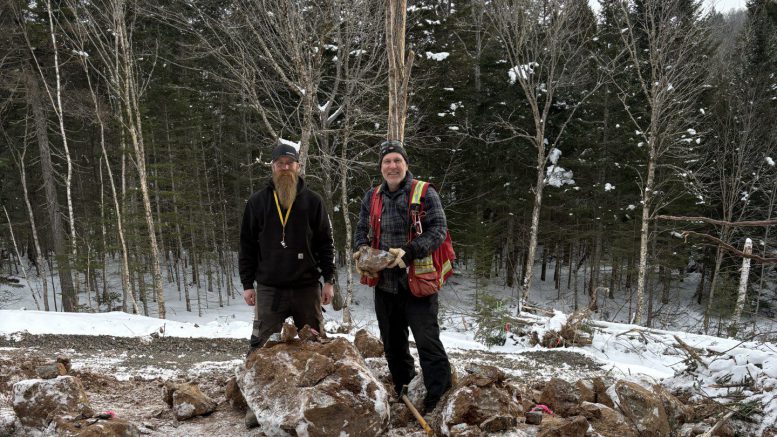
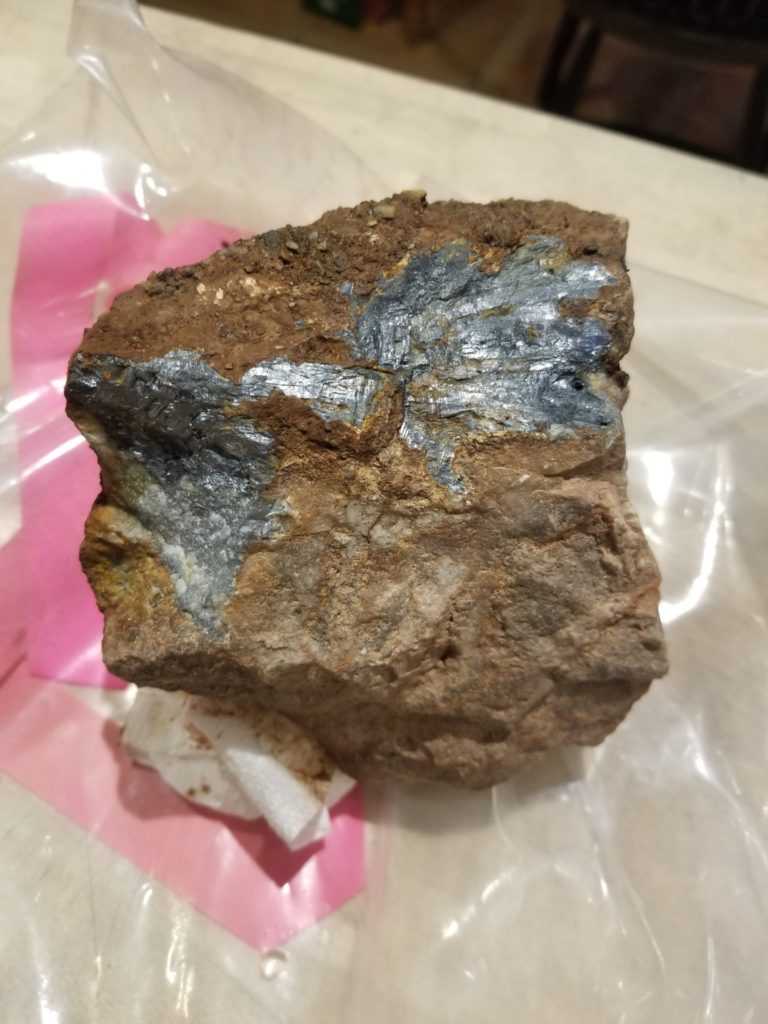
Trenching on the southern part of the property has identified boulders and outcropping bearing stibnite – the main source of mineral antimony – over a distance of 150 metres.
Another area – the Marcus (West) zone – was discovered this year when the company was digging new roads to carry out further drilling. Despite its proximity to the main zone, the team says it could represent a parallel but separate zone of mineralization.
“These are really new occurrences that haven’t been explored at all,” explains Atkinson. “It’s telling me that I think we have a fairly large mineralizing system here that we need to further explore.”
Sampling and trenching on all the new zones will be carried out as part of this year’s $3-million (US$2.2-million) exploration program.
Studies
Once the maiden resource is complete, Antimony Resources expects to accelerate its development timeline by beginning prefeasibility or feasibility studies, as well as initiating baseline environmental studies required for permitting. The company is also conducting a technical analysis to compare potential mining methods for what is likely to be a compact underground operation.
“We’re trying to shorten up any timeline for permitting and technical development,” the executive explains.
If permitting and engineering proceed on schedule, the company could be in a position to decide on project construction by the end of the decade, with first production potentially coming a year or so later
The project’s location in southern New Brunswick offers another advantage. The site is easily accessible by road, close to key power lines and located less than 50 km from a deepwater port.
Provincial efforts to modernize mining regulations and attract critical minerals investment should facilitate development. Authorities are rolling out a Comprehensive Minerals Strategy Framework, which includes a proposed one-stop permitting process to reduce lead times for mining projects. A final version should be ready by spring 2026.
Bathurst Camp
Historically a productive mining jurisdiction, New Brunswick is home to the world-renowned Bathurst Mining Camp, one of the largest zinc districts globally. Officials are now focused on rejuvenating exploration for critical minerals like copper, tungsten and zinc.
Antimony is another. Although the antimony market is relatively small compared to other commodities, its applications in energy, military and safety make it a key component of the 21st century industrial economy.
Its main application is as antimony trioxide, a flame retardant which is often a legally required component in everything from children’s clothes and car seats to military tents and uniforms.
As a hardener for lead, it is also widely used in electric batteries in cars and trucks, and can also be found in newer energy storage technologies such as molten salt batteries. These are expected to become more common as the world turns increasingly to renewable energy.
But as geopolitical tensions rise across Europe, Asia and the Middle East, it is antimony’s military applications that are attracting most attention.
As well as toughening up lead-based ballistics and protecting troops from the risk of fire, it can also be found in communications equipment, night vision goggles and laser sighting devices. As Europe and other countries rush to expand military spending in the face of aggression on their borders, demand is set to expand significantly.
The onus is on western governments to secure sources of such critical minerals, especially when controlled by potentially hostile powers. China, Russia and Tajikistan account for more than 90% of the world’s antimony production and until recently China supplied more than half the antimony imported by the United States.
Trade spats
However, in September 2024, authorities in Beijing halted all exports of the antimony (plus gallium and germanium) citing their importance in military applications. The ban was temporarily suspended last November (until later this year) but has sent companies and governments scrambling to secure supplies of the metal.
In response, antimony prices have soared to record levels with prices for antimony trioxide hitting record levels above US$50,000 a tonne late last year – although they have since declined since the export ban was lifted.
The risk to supplies has forced countries to identify alternative sources and build new processing capacity.
In the U.S., backed by government funding, Perpetua Resources (TSX: PPTA) is constructing the Stibnite gold-antimony project in Idaho, potentially providing the country’s first domestic source of antimony in almost a decade. However, the mine will meet just 35% of U.S. demand during its first six years of operations.
Other antimony projects looking for U.S. government support include a joint venture between United States Antimony (NYSE: UAMY) and Americas Gold and Silver (TSX: USA) to build a hydrometallurgical facility to process antimony-bearing ores in Idaho.
“It’s a critical metal that is in very short supply in North America. It explains why’s there so much interest,” notes Atkinson.
Financing
Although antimony is not as widely recognized as other critical minerals, investors are paying closer attention. In late 2025, Antimony Resources successfully completed a private placement raising over $10 million, providing more than enough to support its exploration programs through 2026.
The company’s shareholder base includes major investment funds such as Delbrook and Dynamic, as well as a network of insiders and retail investors who have supported the company since its inception.
It is not Atkinson’s first experience in the antimony industry. Earlier in his career he worked at the Lake George mine in New Brunswick which was then North America’s largest producer of antimony, accounting for around 10% of global supplies before it shut down in 1996.
The preceding Joint Venture Article is PROMOTED CONTENT sponsored by Antimony Resources and produced in co-operation with The Northern Miner. Visit: www.antimonyresources.ca for more information.
Be the first to comment on "Sponsored article: Antimony Resources targets ‘world’s highest-grade deposit’"