
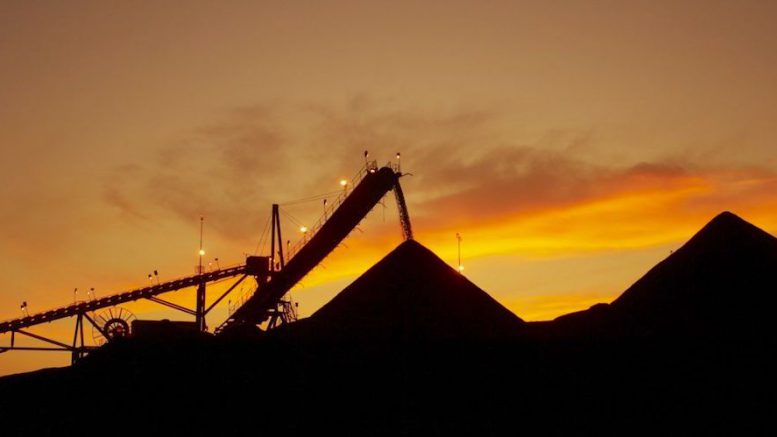
Thermal coal could climb 46% per tonne if the Iran War disrupts liquefied natural gas producers for another month or two, reopening a profit window for major Australian coal miners.
The price for a tonne of the fossil fuel used primarily for electricity could rise to $165 to $185 (C$226.50-C$254) per tonne after Thursday’s missile strike on Qatar’s main LNG export hub, according to Bloomberg Intelligence (BI) senior industry analyst Alon Olsha. Metallurgical coal used in steelmaking is less affected so far, he said.
“When something goes wrong, whether it’s LNG or hydro or weather, coal becomes the only kind of scalable fallback option fuel,” Olsha told The Northern Miner in an interview on Thursday. “Energy security has really reasserted itself as a policy priority.”
The war is pushing utilities back to the old fallback trade: burn more coal when gas gets too scarce or too expensive. But it doesn’t mean a repeat of 2022 when Europe’s loss of Russian pipeline gas and other factors drove Newcastle thermal coal, a major coal price benchmark, to about $460 per tonne, Olsha said.
“Today the disruption is very much concentrated in LNG,” Olsha said. “Europe has less coal capacity, North Asian utilities are tied more into long-term LNG contracts and many of the Asian power systems already actually rely to quite a lot of extent on coal.”
Fossil switching
The coal case rests on gas-to-coal switching, but the physical market has yet to confirm it. BI says JKM – the Japan Korea Marker, a benchmark price for spot LNG cargoes delivered into North Asia – at about $20 per million British thermal units supports Newcastle coal at $165-$185 per tonne, rising to $180-$240 if LNG disruption lasts beyond three months.
Newcastle has already climbed about 20% to $134-$135 per tonne, but exports from Newcastle and Indonesia’s Samarinda remained subdued through early March, suggesting the rally still reflects precautionary buying and logistics stress more than a full demand shift, Olsha said.
Profit gains
If the move does broaden, the biggest gains should go to Australian producers with the fastest exposure to North Asia. China-backed Yancoal (ASX: YAL) and Australia’s New Hope (ASX: NHC) have the most leverage at current prices, with BI estimating about 60% upside to their 12-month earnings before taxes, depreciation and amortization (EBITDA) outlook if Newcastle coal holds near current spot levels.
New Hope sells mostly high-calorific-value thermal coal into North Asia under contracts linked close to shipment, which lets higher prices feed through within weeks, Olsha said. Yancoal sells both high- and mid-calorific-value coal and could also benefit if Indonesia tightens exports, leaving more room for Australian supply in the mid-calorific-value market.
Another Australian producer, Whitehaven Coal (ASX: WHC), would still benefit, though less directly. Its $3.2 billion purchase of the Blackwater and Daunia metallurgical coal mines in Queensland’s Bowen Basin in April 2024 shifted more of its portfolio toward steelmaking coal and reduced its leverage to a thermal coal rally.
Swiss-based Glencore (LSE: GLEN) offers a different kind of upside. Its thermal coal business spans Australia, South Africa and Colombia, which gives it less direct sensitivity than the Australian pure plays. But its energy trading arm gives it another way to profit from dislocation across coal, LNG and oil, as it did during the Russia-Ukraine shock, Olsha said. Peabody Energy (NYSE: BTU) appears less exposed than the Australian names because it has less leverage to Asian seaborne demand.
In North America, the read-through is narrower. The real pricing leverage sits in Asian seaborne coal, not in a revival of coal-fired power demand in Canada or the United States. The U.S. Energy Information Administration expects coal to supply about 16% of U.S. power generation this year, while Canada is still moving toward a 2030 phaseout of unabated coal-fired electricity. For North American producers, the upside lies more in export markets than in domestic burn.
Sentiment shift
Investor hostility towards coal has eased as ESG (environmental, social and governance) pressure has softened and energy security has moved back up the policy agenda, Olsha said.
But he does not expect banks and investors to reopen the door to the weakest thermal coal projects (think regulators permitting lignite mines), or for diversified miners to rush back into coal acquisitions. Most majors have already sold those assets and show little appetite to reverse course.
The longer-term demand call remains open. Olsha said it is still too early to say the world has reached peak thermal coal demand, even as renewables take a larger share of the power mix. The harder question is supply.
Years of underinvestment mean coal can stay tight even if demand flattens, which could keep prices firmer for longer than many investors expect.
“The bigger question is will supply keep up or will it actually lag, which could lead to higher prices down the line,” the analyst said.
Be the first to comment on "War-driven LNG squeeze revives thermal coal: analyst"