
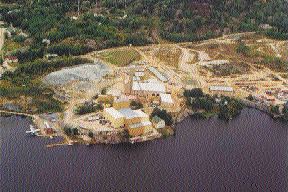
The Bissett gold mine, north of Winnipeg, Man., is about to change hands yet again.
South Africa’s
San Gold, in turn, signed a letter agreement with
The terms of San Gold’s letter agreement with Harmony, signed in late 2003, allow for a 90-day option and due diligence period. Three payments of $50,000 will be made during this period; then the joint-venture partners will pay Harmony $3.5 million and provide shares valued at a further $4 million.
Once the deal is completed, the so-called Rice Lake joint venture will hold 100% of the Bissett mine (formerly known as San Antonio), a 1,200-ton-per-day mill and related infrastructure, and control a large, prospective land package surrounding the mine.
“Putting the two properties together is key to making this [project] work,” says Hugh Wynne, president of San Gold. He notes that the favourable geological horizon hosting the gold deposits at Bissett extends for more than 15 km on the combined land package.
“It’s vastly under-explored, with only four kilometres of the structure tested to date,” he says. “There’s real ‘blue-sky’ here.”
San Gold will manage exploration, and Gold City will be responsible for development and mining. Also, a management committee will be formed with equal representation to manage the overall joint venture. Gold City’s president is Fred Sveinson, a seasoned mining engineer.
Bissett started up in 1932, and operated continuously until 1968, during which time it produced 1.36 million oz. gold from 4.8 million tons of ore. That’s most of the 1.7 million oz. gold produced in the entire Rice Lake greenstone belt.
Since 1994, various companies have spent more than $120 million in efforts to squeeze more gold from the aging mine. Rea Gold launched a program in 1996 aimed at achieving 1,000 tons per day, but ore-handling problems frustrated this goal, and the company ended up declaring bankruptcy in 1997, before production began.
Fortunately, though, the A shaft had been deepened to 4,200 ft., eliminating the need for two of three internal winzes. The A shaft is now directly linked with the D winze, where Harmony began production and where the bulk of remaining resources lie.
Harmony acquired the mine in 1998 for an estimated $14.3 million, with a view to establishing a foothold in North America. The company finished the construction phase and produced 110,000 oz. gold before shutting down the operation in 2001 — a decision based on low gold prices and on Harmony’s decision to expand in South Africa and elsewhere (when Harmony came to Canada, it was producing less than 1 million oz. gold per year; today it is the world’s fifth-largest producer).
“The end result of past efforts is that we’ll have a mine with modern infrastructure, including a high-speed, state-of-the-art loading and haulage system,” Wynne says.
When operations ceased in 2001, Bissett’s geological resources stood at 2.1 million tons grading 0.27 oz. gold per ton for a total of 568,568 contained oz. The estimate was prepared by Harmony’s mining staff (under the supervision of a qualified person). All the resource is accessible by existing mine workings, though exploration drilling has intersected vein systems more than 900 ft. below the deepest level of the mine.
The Rice Lake joint venture intends to take a different approach to production, Wynne notes. Harmony used long-hole stoping in order to boost throughput, which resulted in low head grades. Since Bissett is a typical quartz-vein-type deposit that pinches and swells and meanders, the partners intend to use conventional shrinkage stoping. The use of selective mining will reduce throughput to an estimated 500-600 tons per day but should keep head grades at about 0.25 oz. (near historic levels).
“We plan to use the extra mill capacity to handle tonnage from outside deposits, including ones we’ve found on our land package,” Wynne says, adding that Bisset has key advantages over mines in eastern Canada’s greenstone belts, such as Red Lake.
“A big plus is that ground conditions are ideal, and no back-filling is required, even at depth,” he explains. “The second plus is that it’s a dry mine and develops virtually no water.”
Wynne is enthusiastic about the potential for new discoveries, which isn’t surprising considering he has spent almost 25 years exploring the greenstone belt.
In recent years, San Gold has found three near-surface gold deposits that could be developed to provide feed for the Bissett mine.
Plans are in the works to put down a decline ramp and extract a bulk sample from the No. 1 deposit as soon as possible. The deposit is a mere 3 km from the Bissett mill.
“We almost had a deal with Harmony to mine this deposit a few years ago,” Wynne says, “but gold prices were so low it didn’t make sense to accept the offer. Now, with gold prices being what they are, we’re glad we waited for all the elements to come together.”
Wynne says the deal to acquire Bissett is expected to close within weeks.
Although best known for its diamond projects in Alberta,
The drilling is aimed at finding the westward extension of the Bissett mine mineralization.
The junior notes that the 22.2-sq.-km Strike Point property is several times larger than the Bissett mine property and has the potential for two gold-target types.
A shear zone and adjacent rocks form one target type; the other consists of vein-flooded tension gashes formed by shattering of brittle felsic pyroclastic rocks during folding. The target types coincide in several places along an east-west shear zone.
Marum also plans to drill targets in an entirely different geological setting, on the northern side of the Wanipigau regional fault, which extends eastward 130 km to the Red Lake gold camp of Ontario.
Drill holes will be angled near and under the Vanson and Luana exploration shafts, which were sunk more than 60 years ago to follow high-grade gold zones.
Be the first to comment on "San Gold, Gold City team up to buy Bissett mine"