
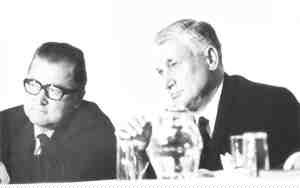
Unlike fellow financier Joe Hirshhorn (1899-1981), Stephen Roman (1921-1988) was a builder, albeit a slow one.
The portly gentleman immigrated to Canada in 1937 after attending agricultural college in his native Slovakia. He settled near Toronto and found work as a tomato-picker. Roman and his brother George, who also immigrated to Canada, gathered enough money to buy their own farm. The business, a modest success, was cut short by a tour of duty in the Second World War.
Upon his return to Canada, Roman began playing the penny stocks on the Toronto Stock Exchange and eventually invested $10,000 in the Concord Mining Syndicate. In 1953, he sold his Concord shares for $2 million following the syndicate’s discovery of oil near Leduc, Alta.
Later that year, Roman was a approached by David Fingard, whom he knew through his Bay Street wheeling and dealing. Fingard had news of a parcel of 83 claims held by Arthur Stollery (1914-1994) in the Elliot Lake area. Stollery was asking $1 million for the property, and was quickly turned down. But Roman was never one to let a good deal get away, so he put in a call to Ralph Benner, a geologist who had worked for him during the Elliot Lake staking rush. Although Benner did not stake any claims himself, he was familiar with the Stollery claims and told Roman they could be valuable.
On a hunch, coupled with his keen business sense, Roman offered Stollery $30,000 and 500,000 shares in North Denison, a company Roman owned. Stollery reluctantly accepted. A year later the company was restructured and named Consolidated Denison.
The claims were drilled in the spring of 1954. The first hole, drilled south of Rio Algom’s Quirke property, showed no signs of ore, but Benner, who was managing the program, was not disheartened. After closely studying the maps, he decided that the second hole would be drilled two miles to the east, on the western side of Quirke Lake. The hole returned grades of 2.8 lbs. uranium per ton — the highest grade drilled on the “Big Z” sedimentary contact.
At the time, Hirshhorn had an option to buy 1 million shares of Denison at $1.25 per share, but he decided to low-ball Roman by offering only $1 per share, figuring that Roman was too cash-strapped to finish the drilling program. Roman refused Hirshhorn’s offer and raised the money via the Toronto Stock Exchange. Drilling started and the Slovak entrepreneur soon realized that his claims contained the largest uranium deposit ever discovered. Denison shares eventually reached $82.
After being bought-out by Rio Tinto, Hirshhorn left Elliot Lake and the mining business to pursue other ventures in Toronto and the U.S. But Roman stayed, determined to turn Denison into “a great multi-national corporation.”
However, contracts to supply the American military with uranium for atomic weapons dried up, and Denison was left holding the bag. Over the next decade, uranium mining was reduced to a fraction of what it was only years before, with most of the production bought and stockpiled by the Canadian government.
In pursuit of “multi-national” status — and survival — Roman diversified his company. Denison and its affiliate Roman Corp. (both of which still exist) bought potash interests in New Brunswick, and oil and gas properties in western Canada, Egypt, Spain and Greece. Also, in the early 1970s, Denison secured the lease to the Quintette metallurgical coal property, 100 km south of Dawson Creek in northeastern British Columbia. In 1977, Imperial Oil, Canada’s largest oil company at the time, bought a 16.75% interest in Quintette to help bring the massive project to production. In 1980, it was milling at the rate of 1 million tons per year.
But it was also in 1977 that the company’s uranium mines put Denison back on the map. Roman secured a deal to provide Ontario Hydro with 126 million lbs. of uranium oxide between the years 1980 and 2011. The power company wanted the uranium to run its nuclear power plants, and the deal was worth an estimated $5 billion — the richest mining contract ever signed. Elliot Lake was booming again.
These deals, and others, prompted The Northern Miner to declare Stephen Roman its first “Mining Man of the Year,” for 1977.
By 1983, the Denison mine had increased its daily milling capacity to 15,000 tons, and the company was generating $675 million in revenue, with projections of $2 billion and $3 billion for the years ahead.
But it was not to be. Ontario Hydro realized it could purchase uranium in Saskatchewan for less than half of what it cost in Ontario. The writing was on the wall.
In the midst of the downturn, workers from the Denison mine paraded through the streets of Elliot Lake protesting an announcement that 23 workers would be laid off. News of the layoffs came on the heels of Roman’s purchase of a purebred Holstein cow for the sum of $1.45 million.
But this was not the only example of his largesse. In the mid-1980s, Roman, a devout Catholic, built the $25-million Cathedral of the Transfiguration on his 1,200-acre Romandale farm, near Unionville, Ont. (Pope John Paul II blessed its cornerstone during his 1984 visit to Canada.) The financier also owned a 17-room Tudor-style mansion, a villa in Nassau and $10-million summer house in Elliot Lake.
Roman died on March 23, 1988, and was survived by his wife, Betty and seven children. His oldest child, Helen, assumed control of Denison, a company many millions of dollars in debt.
Roman built Denison into a company that, at its peak, was worth $2 billion. Not bad for a tomato-picker.
Next week: Bob Hart.
— The author, a retired mining engineer, resides in Barrie, Ont.
Be the first to comment on "Roman’s empire not built in a day"