
Long before Robert Friedland’s
QGX was incorporated in 1994 with the sole objective of exploring the mineral potential of Mongolia. That same year, it became the first Western company to be granted a mineral exploration licence in Mongolia, following the adoption of new mining laws after almost 70 years of Soviet rule. QGX’s original concessions were in the South Gobi region, where it carried out exploration from 1994 to 1998, uncovering several copper-gold porphyry prospects. One such prospect, Kharmagtai KH7, showed early promise, returning 72 metres of mineralized stockwork grading 1.89% copper and 3.08 grams gold per tonne from scout drilling in 1997.
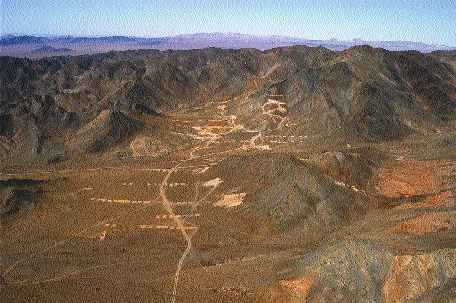
QGX joint-ventured the Kharmagtai, Ovoot Hyar and Shuteen prospects to Ivanhoe in March 2002 in return for a 10-to-20% carried interest in the projects. It is estimated that Ivanhoe has since spent more than US$5 million exploring the Kharmagtai and Ovoot project areas, completing more than 30,000 metres of drilling on several targets. Ivanhoe has drilled off a preliminary in-house resource in two pipe-like stockwork zones at the Gold Hill (Altan Tolgoi) prospect at Kharmagtai for a contained 28 million tonnes grading 0.41% copper and 0.51 gram gold, based on a cutoff grade of 0.4% copper-equivalent. The Kharmagtai exploration licence is 120 km north of Ivanhoe’s Oyu Tolgoi (Turquoise Hill) project and covers 67 sq. km.
QGX remained private for eight and half years before going public on the TSX Venture Exchange in August 2002. Since then, QGX has raised $25 million and selectively acquired 70 exploration licences covering more than 40,000 sq. km in Mongolia.
“It looks like a shotgun pattern through the country, but there is a reason why those leases are in those locations,” explained David Anderson, co-founder and CEO of QGX, who was speaking at BMO Nesbitt Burns’ recent Global Resources conference in Tampa, Fla.
The company’s share price has taken off from an initial list price of 50, peaking at $7.30 before falling back to around $4. QGX has 32.1 million shares outstanding or 35.2 million on a fully diluted basis, with $18 million in the bank.
QGX’s flagship project is the Golden Hills massive sulphide discovery, made in October 2002 in the northwestern part of the country, where drilling has intersected encouraging gold-silver values in a near-surface gossanous oxide layer that overlies deeper, copper-bearing massive sulphides, with precious metal credits. “Our efforts since then have shown clearly that the discovery has exciting potential, not only in the immediate area but on strike,” said Anderson.
Expertise
The Golden Hills property (or Bayan Airag as it is known in Mongolia) is in the province of Zavkhan, 140 km west of the provincial centre of Uliastai and 900 km west of Ulaanbaatar, Mongolia’s capital city. By spending US$450,000 before July 2005, QGX can earn an initial 80% interest in the original, 70-sq.-km licence. The remaining 20% held by Gurvon Gol can be bought out for a payment of US$1 million. QGX has added to its land position and now controls 7,500 sq. km in the Golden Hills area.
QGX originally optioned the Golden Hills property in 2002, based on an outcropping package of altered rocks containing in excess of 10 grams gold in grab samples. Field crews identified sub-cropping, quartz-chalcedonic boulders over a distance of 500 metres in a large alteration system. Chip samples taken along the boulder train in the Central Valley zone ran as high as 145 grams gold. Of the 121 initial chip samples collected, 30% returned values greater than 0.5 gram gold, while 21 samples yielded better than 1 gram. A chip sample from a 3-metre-deep pit returned 3.91 grams over 2 metres.
An induced-polarization and magnetic survey revealed several anomalies along the interpreted axis of the system. Subsequent work has identified more than one mineralized zone, including the Central, South and North zones, which appear to converge and then spread out to different conductors to the east. “It’s unclear at this point how each of these zones continue over to the east, and we just collectively call these three areas the East zone,” says Paul Zweng, QGX’s chief operating officer.
Same setup
In October 2002, a first pass of drilling consisting of seven holes tested the western end of a target area measuring 3 km long by 300 metres wide. The two discovery holes in the Central zone were drilled from the same setup on section 9920. Collared at minus 47, the first hole intercepted 48 metres of oxide or gossanous mineralization averaging 3.78 grams gold and 56.4 grams silver starting at a down-hole depth of 18 metres. The second hole was steepened to minus 67 and hit 71.4 metres grading 2.1 grams gold and 31.6 grams silver, beginning at a depth of 14 metres.
QGX stepped back from this section and undercut the first two holes with the fourth hole, intersecting 11 metres of 1.04 grams gold at a down-hole depth of 146-157 metres. Moreover, hole 4 provided the first glimpse of massive sulphide mineralization at depth.
Up to hole 39, QGX had focused on chasing down and testing the gold-bearing gossans in the Central Valley and South zone areas (32.5 metres of 13.8 grams gold and 10.8 grams silver), clipping the underlying sulphide mineralization. By hole 40, the company decided it was time to poke one hole into the North zone, the strongest of all conductors detected by a ground electromagnetic survey.
Hole 40 was drilled last summer on section 10400 and intersected 131 metres of massive sulphides, including an upper 31.5 metres grading 3.4% copper, 0.8 gram gold and 20.1 grams silver. This section was undercut by holes 43 and 44, which show the copper mineralization thickening at depth but with declining grades. Hole 43 intersected 53 metres grading 1.61% copper, 0.52 gram gold and 7.8 grams silver starting at 134 metres down-hole, whereas hole 44 cut 62.5 metres of 1.42% copper, 0.37 gram gold and 7.9 grams silver beginning at 261 metres of depth.
“Besides having gold and copper in the massive sulphides, we are also getting gold in a number of areas below the massive sulphides,” notes Zweng. He points out that hole 40 also cut 40 metres of about 1.5 grams gold in sulphide-bearing schist below the massive sulphides.
The Golden Hills property is underlain by the Middle Riphean Shuvuun Formation, a Proterozoic-age sequence of quartz-bearing schists, marble, sandstone and limestone intruded by both mafic and felsic dykes and sills. The quartz-bearing schists are interpreted as intermediate-to-felsic metavolcanic rocks, some of which have pyroclastics textures. The primary massive sulphides occur below the base of weathering and consist of massive pyrite-chalcopyrite mineralization (90-95% pyrite) and associated gold-silver. Supergene enrichment is present below the base of oxidation. The massive sulphide mineralization has been intersected in drilling over a strike length of 1 km and traced down-dip for 300 metres. The Shuvuun Formation, itself, has a strike length of multiple tens of kilometres, most of which QGX now controls.
A series of high-grade, gold-bearing feeder-type veins has been intersected in drilling, either immediately above or below the massive sulphide. Highlights from recent drilling include the following:
— hole 59 — 0.95 metre grading 29.1 grams gold and 24.1 grams silver;
— hole 60 — half a metre grading 448 grams gold and 705 grams silver;
— hole 63 — 1 metre of 43.2 grams gold and 89 grams silver;
— hole 66 — 1 metre of 70.1 grams gold.
“We are keeping our antennae out in the hope that we might find a broader, high-grade gold zone,” says Zweng.
Gossan zones
QGX has completed 78 holes to date at Golden Hills, with assays reported for up to hole 66. Two core rigs are targeting the deeper massive sulphides, while a reverse-circulation (RC) rig is being used to prove up the gossan zones as part of an 80-hole RC program. By this summer, QGX wants to be in a position to produce both a resource on the gossan and the massive sulphides.
In recent drilling, the first hole to test the underlying massive sulphides in the South zone intersected 33.5 metres grading 7.4% copper, 0.7 gram gold and 9 grams silver in hole 65. This same hole also intersected 25 metres of 9.7 grams gold and 89 grams silver in the upper Central zone gossan.
Zweng says the Central, North and South zones represent an aggregate strike length of 2.2 km based on geology and geophysics.
Preliminary metallurgical tests suggest the gossan mineralization is amenable to heap leaching. On a coarse crush half-inch fraction, half the gold leaches in 24 hours with final recoveries of 75% for gold and 45% for silver. At finer grind, recoveries are 84-88% for gold. Ongoing tests on the massive sulphide materials are trying to determine how well they can be separated and floated.
A scoping study is looking at both a stand-alone gold-silver gossan project and a stand-alone copper-gold-silver concentrate project.
Some of the other major projects QGX is advancing include Uhaa Hudag, Erdene Tolgoi and Onon. Uhaa Hugag is a mesothermal gold quartz-vein target, similar to the Timmins-Kirkland Lake-type target, which is scheduled to be drilled during the second quarter. Erden Tolgoi is a copper-gold porphyry target in eastern Mongolia, and Onon is low-sulphidation epithermal gold target, near the Russian border in the northeastern part of the country.
Be the first to comment on "QGX paves way for mineral exploration in Mongolia"