
Discoveries by majors do not often receive the attention or accolades they deserve, as in the case of Cortez Hills in Nevada. Discovered by
In the span of a year, the company has added in excess of 5.2 million oz. in proven and probable gold reserves to the Cortez mine, coupled with a further 544,000 oz. in measured and indicated resources and 1 million oz. in the inferred category.
“Cortez Hills has been a great success for us,” said Geoff Handley, Placer Dome’s executive vice-president of strategic development, at a recent gold conference sponsored by Prudential Equity Group.
The Cortez Hills discovery, along with the nearby 1.2-million-oz. Pediment deposit, discovered several years ago, will extend the life of the Cortez mine proper to at least 2014.
The Cortez mine lies along the Battle Mountain trend in north-central Nevada, 100 km southwest of Elko. Placer Dome is the operator and owns a 60% interest in the mine, which employs about 380 people. The remaining 40% interest is held by
In 2003, for the sixth-consecutive year, the mine produced more than 1 million oz. Specifically, the joint venture produced just shy of 1.1 million oz. from open-pit mining operations on the Pipeline and South Pipeline deposits. The mine uses integrated milling and heap-leach processing to recover gold from oxide mineralization.
Lower-grade oxide ore is hauled directly to heap-leach pads, whereas higher-grade non-refractory ore is treated in a conventional mill using cyanidation and carbon-in-leach (CIL) processing. Preg-robbing refractory carbonaceous ore is stockpiled and sold for outside roaster processing at third-party facilities.
The processing facilities at Cortez have gone through several stages of improvement and expansion over the years. The original mill facilities (mill no. 1) went into production in 1969 with a nominal capacity of 1,800 tonnes per day. A fluid-bed roaster was added to the mill in 1990 to process refractory ore. The roaster operated until March 1996, when it was closed down.
In 1996, concurrent with the development of the Pipeline and South Pipeline deposits, which were discovered in 1991, Cortez purchased new open-pit mining equipment and constructed a carbon-in-leach (CIL) gold recovery plant (mill no. 2) capable of operating at 9,100 tonnes per day at a cost of US$250 million. The CIL plant was commissioned in March 1997, and oxide ore was processed through both mills until mill no. 1 was shut down in October 1999.
A new leach pad and process plant, designed to handle 164 million tonnes of lower-grade, heap-leach ore over the life of the mine, came on-stream in 2002. A production history of the Cortez mine from 1991 is provided in the accompanying table on page 22.
In 2003, Cortez produced 1,065,402 oz. (61% mill, 31% heap leach and 8% carbonaceous ore sale) from the processing of 24 million tonnes of ore grading 1.78 grams gold per tonne at a cash cost of US$135 per oz. and a total cost of US$172 per oz. This compares with 1,081,677 oz. (66% mill, 27% heap leach and 7% carbonaceous ore sale) recovered in 2002 from the treatment of 14.4 million tonnes grading 2.7 grams at cash and total costs of US$129 and US$168 per oz., respectively. Declining grades in 2003 were partially offset by increased heap-leach tonnage.
Gold production in 2004 is forecast at 940,000 oz. (46% mill, 46% heap leach and 8% carbonaceous ore sales), some 12% lower than in 2003, owing to significantly lower mill grades offset by higher heap-leach tonnage. Mine production in 2004 is scheduled to be sourced primarily from the South Pipeline deposit. Cash and total production costs are expected to rise 26% to US$170 per oz. and 28% to US$220 per oz., respectively, compared with 2003, reflecting lower-grade mill ore, increased cyanide costs (resulting from an increase in the amount of heap-leach tonnage treated), and higher electricity costs.
In the first three months of 2004, Cortez produced 282,512 oz. (48% mill, 46% heap-leach and 5% carbonaceous ore sales) from the processing of 10.1 million tonnes of ore grading 1.2 grams. As expected, production was off 11% from the corresponding period of the previous year. Cash costs came in at US$160 per oz.; total costs, US$200 per oz.
For 2004, capital expenditures at the mine are pegged at US$91 million, including US$47 million for mobile mining equipment and US$28 million for tailings and heap-leach construction.
In October 2003, Cortez entered into another contract to sell 430,000 tonnes of carbonaceous ore to Barrick Goldstrike Mines.
Placer is currently investigating the viability of treating the refractory carbonaceous ore using two new competing processes. One method uses modified cyanide-based leaching processes; the other uses a modified thiosulphate-based heap-leaching process. A feasibility study was initiated in the fourth quarter of 2003 and should be completed by mid-2004. The selected alternative will reduce Cortez’s need to sell carbonaceous ore, thereby reducing costs and increasing the potential to add mineral reserves.
All production by Cortez is subject to a 1.5% gross smelter return (GSR) royalty payable to the former shareholders of Idaho Mining. In addition,
Nine stages
The Pipeline and South Pipeline deposits are being mined by conventional open-pit methods in nine stages. The first three stages occurred between 1996 and 2004. The mining of stages four through nine is scheduled to continue through to 2008. Subject to permitting, the Cortez Hills and Pediment deposits will be mined by open-pit methods through to 2014. Placer assumes Cortez Hills will generate 1 million oz. per year at a cash cost of under US$100 per oz.
All necessary permits for development of the Pipeline and South Pipeline through stage seven, and all stages through the 4120 elevations, are in place and in good standing. The Cortez joint venture filed an amended plan of operation in January 2001 to deepen stages eight and nine in the Pipeline-South Pipeline pit and extend the pit into the Crossroads deposit to the south. The amendment entails mining the Gap pit, between Pipeline and the historical Gold Acres pit. Permitting for Cortez Hills and Pediment will begin once the company has enough drilling data to formulate an operating plan.
“Permitting in the U.S. can be a tedious effort, but I don’t see anything there that’s alarming,” said William Hayes, Placer’s executive vice-president of U.S. operations. “I am confident we’ll get some benefit, or at least I hope we will, out of being able to do joint permitting with Cortez Hills and the Pediment deposit.
The original permitting took 42 months. “But,” said Placer President Jay Taylor, “I would say 2007 is a pretty good target date for expecting some production from that area. Given that the ore is very amenable for processing in the facilities we have in the valley, I think it’s safe to say all you’ve really got to do is get the permitting in place and start stripping the cap off that, and then you’re going to be in production.”
The metallurgical characteristics of the Pipeline and South Pipeline ore have been developed through extensive mill and heap-leach experience and ongoing testwork on-site. According to a technical report by AMEC E&C Services, mill and heap production show stable metallurgical performance consistent with ongoing in-house test programs.
Gold recovery is a function of the processing method (milling, heap leaching and roasting) and of ore type. Mill recoveries range from 84% for South Pipeline O-zone material to 94% for Pipeline oxide ore. Heap-leach recoveries range from 50% for Cortez Hills, Gap and Cortez NW Deeps oxide leach material to 68% for Pipeline and Pediment oxide leach material. Metallurgical recoveries for refractory, carbonaceous mineralization depend on the process used. Roasting followed by milling recovers 85% of the gold.
Ore reserves have been estimated for the Pipeline, South Pipeline, Gap, Pediment and Cortez Hills deposits. These deposits contain additional mineral resources separate from mineral reserves. Mineralization in the Crossroads, Cortez NW Deep and Hilltop deposits are classified as mineral resources only.
Proven and probable reserves at the end of 2003 were estimated at 233 million tonnes grading 1.7 grams, equivalent to 12.7 million contained oz., based on US$325-per-oz. pit models. Additional measured and indicated mineral resources contain another 9.3 million oz. in 297 million tonnes grading 1 gram gold per tonne. A further 1.4 million oz. hosted in 30.5 million tonnes grading 1.4 grams are inferred.
Cortez Hills
Included in the reserves is the Cortez Hills discovery, consisting of 37.5 million tonnes in proven and probable reserves grading 4.36 grams gold per tonne, equivalent to 5.2 million oz. An additional 3.6 million tonnes grading 4.73 grams, representing 544,000 oz., sit in the measured and indicated category, and another 1 million oz., or 7.4 million tonnes grading 4.3 grams, are inferred. The Cortez Hills deposit was drilled on 30-metre centres.
At gold prices higher than US$325 per oz., the extra resource at Cortez Hills quickly converts into reserves, said Handley.
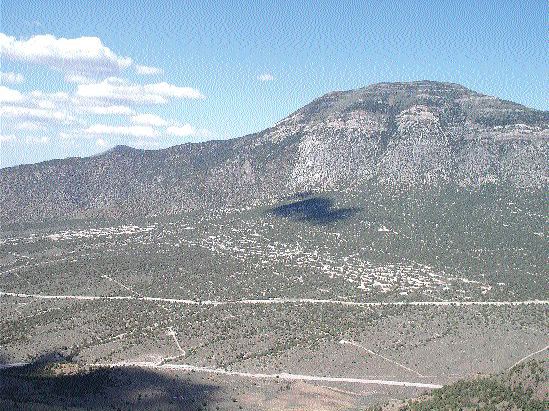
The Cortez area of interest comprises 2,587 sq. km along the Cortez-Battle Mountain trend, of which 825 sq. km are directly controlled by the Placer-Rio Tinto joint venture. The present Pipeline operation is 11 km northwest of the original Cortez milling complex. The Cortez mine is accessible via Nevada State Highway 306, which extends southward from U.S. Interstate 80, both of which are paved roads. Most of the mine facilities are on the western side of the valley at an elevation of 1,600 metres.
The climate is one of high desert mountains, and average monthly temperature ranges from a low of minus 5C in December to a high of 30C in July. Annual precipitation averages less than 25 cm.
Water for processing use at Pipeline is supplied from the open-pit dewatering system. Electrical power is supplied by Sierra Pacific Power Co. through a 73-km-long transmission line.
The Pipeline-South Pipeline mine and mill no. 2 are at the southern end of the Crescent Valley in Lander Cty. Crescent Valley is a structural and topographic basin between the Northern Shoshone range on the west and the Cortez range on the east.
Multiple deposits
Gold mineralization in the Cortez joint venture occurs as multiple deposits hosted by Paleozoic carbonate rocks, siliceous metasediments and felsic porphyry intrusions. Carlin-style, sediment-hosted disseminated gold mineralization is the main target of exploration in the mine area. The typical deposit is structurally controlled, with sub-microscopic gold particles distributed throughout strongly altered sedimentary host rocks. Gold is associated with anomalous arsenic, antimony and mercury.
The gold deposits of the district lie along the western margin of the Crescent Valley at the foot of the Shoshone range (Pipeline, South Pipeline, Crossroads, Gap and Gold Acres) or within the southern end of the Cortez range (Cortez, Cortez NW Deep, Cortez Hills, Pediment). The regional geology consists of deep-water siliceous rocks and shallower carbonates of the Paleozoic Roberts Mountains Formation.
Gold mineralization in the Cortez joint venture occurs in the lower-late carbonates within folds and horst blocks adjacent to major north-northwest- and northeast-oriented normal fault structures and Mesozoic intrusive stocks. The Silurian-age Roberts mountain formation and the Devonian Wenban limestone are the principal hosts of gold mineralization. The intersection of north-northwest- and northeast-striking faults is a controlling factor.
The Pipeline, South Pipeline and Crossroads deposits are separate zones of the same mineralized system hosted by altered, sheared dolomitic siltstones of the Roberts mountains formation. The deposits occur in sequence from northwest to southeast along a high-angle fault and are entirely concealed beneath Quarternary pediment gravels that are up to 100 metres thick. The extensively altered and mineralized system is more than 3 km long and 1.5 km wide.
The Pipeline deposit was discovered by the Cortez joint venture in March 1991 during drilling of deep condemnation holes on the pediment east of Gold Acres. Early signs of the South Pipeline deposit were discovered by Royal Gold during drilling campaigns in 1990 and 1991. Shortly afterward, the Cortez joint venture assumed the role of operator and discovered the South Pipeline deposit.
Crossroads
Continued drilling along the northwest structural trends at Pipeline resulted in the 1998 discovery of the Crossroads deposit under 170 metres of alluvium southeast of South Pipeline. Most of the Pipeline, South Pipeline and Crossroads mineralization is oxidized.
The Pipeline deposit is a low-angle, tabular-shaped body measuring 460 by 230 metres, with a thickness ranging from 15 to 100 metres. The top of the deposit is 150-180 metres below surface.
South Pipeline consists of two zones — a shallow one, between 20 and 46 metres from surface, and a deeper one that begins at a depth of 305 metres. The shallow zone, referred to as the Crescent pit, is about 90 metres thick and extends 550 metres in a northerly direction by 600 metres in an easterly direction. The deep zone is up to 75 metres thick and covers a 60-by-180-metre area. Crossroads is a deeper extension of the South Pipeline lower zone to the southeast.
The Gap deposit lies west of Pipeline. It is hosted by a weakly altered and oxidized Devonian carbonate sequence, known as the Wenban limestone, and by local skarn. Mineralization occurs in the axial zone of an anticline along well-developed north-northwest-striking fault zones. The oxide mineralization is similar to that at South Pipeline, though the host rocks are somewhat different. The Cortez joint venture predicts that the oxide mill ore from Gap will have a similar recovery to oxide mill ore from South Pipeline. Leach material from Gap, however, will have a somewhat lower recovery in comparison to South Pipeline leach ore.
The Hilltop deposit is 26 km northwest of Pipeline complex. There, structurally controlled gold mineralization is found in brecciated, Upper Plate silicified sedimentary rocks of the Ordovician Valmy Formation, as well as Tertiary felsic porphyry. Internal feasibility studies suggest a gold price of between US$425 and US$450 is needed before Hilltop can be economically mined and processed in a combined oxide and bio-oxide heap-leach facility.
In 1996, the Cortez joint venture began to test for hidden mineralization south of the Cortez mine using deep reverse-circulation (RC) holes. Drilling is guided by structural geology, geophysics and geochemistry. Exploration is focused on the lower plate carbonate formations in the search for Carlin-type, bulk-tonnage gold deposits.
“Our focus is on the structural framework and the stratigraphy within which we’re working,” said Robert Hays, exploration and development superintendent at the Cortex gold mines. He was speaking during at presentation at the Mineral Exploration Roundup in Vancouver, earlier this year.
“We evolve our understanding by reconnaissance-level mapping and sampling, and we generate and utilize geophysical and geochemical data, then construct 2-dimensional and 3-dimensional models from that information.”
Gravity and seismic are two of the more useful geophysical tools employed in the joint-venture area that helps reveal the basement fabrics under deeper cover.
The Pediment deposit was found 5 km south of the Cortez mill in 1998. Pediment is a unique landslide deposit derived from an in situ, sediment-hosted deposit. Covered by unaltered colluvium, the top of the deposit ranges from 45 to 170 metres below surface. The deposit is 76 metres thick and measures 915 metres in a northeast direction by 180 metres northwest.
The Pediment mineralization consists of oxide material, with little or no sulphides. Heap-leach tests on drill samples suggest the metallurgical response is similar to Pipeline ore. Tests on Pediment material indicate it is reasonably amenable to milling. Proven and probable reserves for the Pediment deposit are pegged at 38.9 million tonnes grading 0.97 gram, equivalent to 1.2 million oz.
In October 2002, the sixth hole of a 7-hole RC program north of Pediment resulted in the discovery of Cortez Hills. The hole intercepted 36.6 metres of 9.5 grams, and three follow-up holes were drilled around it to confirm continuity.
By June 2003, Placer had drilled off a still-growing resource of 5.5 million oz. During 2003, up to six rigs were used to complete more than 50,000 metres of core and RC drilling. One of the better holes through the deposit core intersected 151 metres averaging 23.8 grams gold per tonne.
Hangingwall
Cortez Hills is hosted in the hangingwall of the Cortez fault system in the upper portion of the Devonian carbonate sequence of chert and laminated siltstone units. The top of the deposit starts 107 metres below surface and is covered by colluvium and landslide debris. The mineralization extends downward at least 430 metres. Mineralization follows the nose of a marble zone in the Wenban limestone unit over an area measuring 550 metres north-south and 245 metres east-west.
Cortez Hills is still open to depth and wide open along strike to the south and southwest toward the Pediment deposit, more than 2 km away, as well as to the west.
With plans for at least 100 holes, the current 2004 campaign will include infill drilling designed to increase confidence in the resources to the measured category, as well as stepout drilling on the gap between Cortez Hills and Pediment. “We don’t know what the potential is until we drill it, but we are hopeful we’ll continue to find ore,” said Handley. “So far there is no reason to say it stops, so we continue to step out, fingers crossed.”
One-hundred holes is just a nominal number, said Taylor.”This is a high-quality reserve. If we continue to get encouragement, we’re going to put as many holes as we have to into that thing to find out where it is.”
Preliminary metallurgical tests of Cortez Hills ore indicate recovery characteristics similar to Pipeline oxide mill feed. More than 90% of the deposit is oxidized on a contained metal basis. Quartz and illite are the most common minerals associated with oxidized gold mineralization.
“Cortez Hills is a quality discovery,” said Hays. “It gave some of the best drill results we ever had, be it development or exploration. Pipeline is a robust deposit; Cortez Hills will actually be better. The Cortez district is a rich district and it’s very under-explored.”
Be the first to comment on "Major find in Battle Mountain trend"