
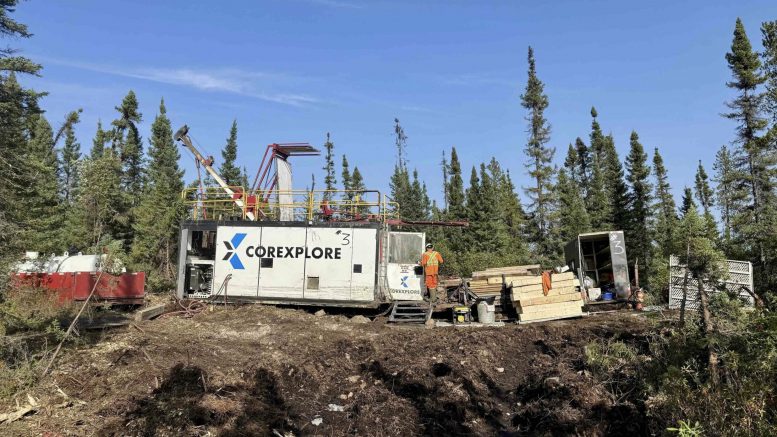
Lux Metals (TSXV: LXM) is planning to seek about $7 million (US$5 million) in flow-through financing this fall to carry its La Grande gold project in northern Quebec towards a first resource by the end of 2027.
The Vancouver-based junior launched a program to drill 4,500 metres at Zone 32, the most advanced target on the 153-sq.-km property in Eeyou Istchee James Bay, roughly 850 km northwest of Quebec City. More than 40,000 metres of historical drilling traced gold over 600 metres of strike and 350 metres depth, but La Grande has no current mineral resource.
“They forgot about the project,” CEO Kim-Quyên Nguyên told The Northern Miner in September, describing how it slipped down former owner Virginia Mines’ priorities after years of work. “We’re revisiting everything.”
Lux is betting new drilling and tighter geophysical surveys can turn a large historical database into a current resource. The test is whether Zone 32’s broad historical grades hold up under modern verification and can anchor a larger system along a 40-km greenstone trend, only about 2 km of which has been drilled.
The wider James Bay district has drawn Agnico Eagle Mines (TSX, NYSE: AEM) and Centerra Gold (TSX: CG; NYSE: CGAU) as strategic investors in Azimut Exploration (TSXV: AZM). Privately held Dhilmar paid US$795 million to buy the Éléonore gold mine from Newmont (NYSE: NEM; TSX: NGT) last year.
Resource test
The drilling program, which began Aug. 25, forms part of a larger 8,800-metre program at the site 85 km southeast of Radisson. Management cut the first round to focus spending on Zone 32, where new drill holes will check the older results, tighten drill spacing and test extensions and nearby structures before Lux commits more money elsewhere.
Historical drill hole LGS97-98 cut 103.8 metres grading 6.52 grams gold per tonne starting at 94 metres downhole, including 83.8 metres at 7.9 grams from 119.2 metres. Drill hole LGS98-125 returned 38.5 metres grading 4.32 grams starting at 225 metres. Farther down-plunge, LGS12-224 intersected 37 metres at 1.9 grams starting at 753 metres, about 400 metres from the main Zone 32 envelope.
True widths haven’t been determined and Lux hasn’t independently verified the historical assays. Quality-control records from drilling before 2003 are incomplete, although a qualified person who inspected representative core considers the database generally reliable.
Old ground
Previous operators drilled 253 holes totalling 52,472 metres between 1996 and 2015, concentrating most of the work around Zone 32. Virginia eventually shifted its focus to other projects, while lower-grade gold in the surrounding tonalite carried less value at the gold prices prevailing when drilling stopped, Nguyên said.
“The cut-off was not the same as it is today,” she said. “It just fell out.”
Lux now wants to model Zone 32 together with nearby mineralized structures rather than treat it as an isolated body. Pari, Brèche, Mico-Milan and Vein zones lie within the same broad corridor, though drilling remains too sparse to establish how, or whether, they connect.
Gold occurrences extend well beyond the drilled area along the 40-km trend, but this year’s program remains centred on Zone 32.
Lux shares were at C19¢ in Toronto on Friday, up 12% over the past six months, giving the company a market value of C$14.3 million ($10 million). They have traded between C9.5¢ and C32.5¢ during the preceding 52 weeks.
Target search
Lux plans a geophysical survey this winter before laying out the next round of holes. The last comparable work dates to 1999 and used lines about 150 metres apart. Management plans to narrow that spacing to about 50 metres to better map structures that may control the gold.
That work explains why Lux didn’t drill all 8,800 metres it had planned this year. Spending on geophysics first should give the company firmer targets outside Zone 32 instead of drilling less-understood ground immediately.
“There’s a hope” of finding another Zone 32, Nguyên said. “But the actual program is not doing it right now.”
Be the first to comment on "Lux seeks $7M to advance Quebec gold project"