
Stronger precious metals prices have re-ignited interest in Mexico’s Sierra Madre gold-silver belt, and among the beneficiaries is
Carmen is a low-sulphidation, epithermal, oxide gold-silver deposit, and part of the company’s past-producing Monterde property in Chihuahua state. The junior can acquire 100% of the property, which also hosts several less advanced targets.
Kimber has a number of former Placer Dome executives on its board (most recently Cliff Grandison), which is not surprising, given that Placer was one of the first majors active in the Sierra Madre region in the 1990s.
Kimber President Robert Longe says the draw was not just the Carmen deposit but the potential to find other silver-gold deposits in an emerging mineral district that bears some similarity to Nevada in its early days.
“It’s one of the few places where it’s still possible to find virginal epithermal systems,” Longe says. “At Carmen, we’re seeing similarities to Bald Mountain, and that’s exciting, because the [Nevada] mine was a solid producer for Placer for many years.”
Like Nevada, which is still known as “the silver state,” the Sierra Madre region has a strong mining heritage, in this case dating back to before the arrival of the Spanish. Historically, most of the mines have been underground operations that extracted only high-grade material.
Whereas Nevada is one of the world’s foremost gold-mining districts, the Sierra Madre region is a newer camp that is only beginning to realize its geological potential. One reason is that, until the mid-1990s, it was not possible in modern times for foreign companies to hold more than a 49% interest in Mexican mineral properties.
Once this law was changed, North American companies flocked to acquire ground in the historic mining district. But by 2000, funding for work programs dried up as gold prices went into a tailspin.
Low gold prices also put a damper on progress at Mulatos, the best known and largest deposit in the region. Then-owners Placer Dome and Kennecott outlined a global resource of several million contained ounces in the 1990s, but production plans came to naught, in part because a higher-grade starter pit was not found. Current owner
Lower costs
Early this year, Alamos released a new resource estimate for Mulatos, as part of a feasibility study for an operation with lower capital costs than were previously envisioned.
Measured and indicated resources at a cutoff grade of 0.2 gram per tonne are estimated to be 140 million tonnes grading 0.88 gram gold per tonne. At a 1-gram cutoff, resources in these categories total 33 million tonnes grading 2.17 grams, or 2.3 million contained ounces. Inferred resources bring the total to 4.8 million oz. at the 0.2-gram cutoff, and to 2.5 million oz. at the 1-gram cutoff.
Other high-profile projects being advanced in the region include the Dolores, Ocampo, El Sauzal and Uruachic deposits, to name but a few.
Longe notes that activity in the camp is picking up steam now that companies are able to raise funds for exploration. Kimber survived some lean years after going public in 1995 but has since managed to boost its treasury to about $6 million for work programs. The junior’s shares jumped to over $2 this year after languishing at the 45 level for most of 2003.
The company is now well funded to advance the Carmen deposit to the feasibility stage by early next year.
Carmen is the most easterly of the five mineralized structures identified at Monterde, each of which is about 500 metres long. Other prospective zones include Las Minitas and El Orito.
A resource estimate, based on the 90 holes drilled by the end of 2003, will be released shortly, after being vetted by a qualified person. This estimate is expected to confirm and possibly expand the resource estimate released last fall.
At last report, measured and indicated resources stood at 4.4 million tonnes grading 1.34 grams gold and 102 grams silver per tonne, or about 190,741 contained ounces gold and 14.4 million contained ounces silver. The deposit also hosts 4.4 million tonnes in the inferred category, at 2.45 grams gold and 111 grams silver.
Five more holes, totalling 1,115 metres, were completed at Carmen early this year. These tested the Dome Fault structure, which cuts across the northern end of the Carmen structure and has been traced on surface for more than 400 metres. Results are expected shortly.
15,000-metre program
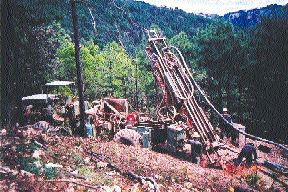
To bring the project to the feasibility stage, Kimber intends to drill about 15,000 metres this year. More metallurgical work is planned, though preliminary work is described as “very encouraging” for both gold and silver.
At the same time, exploration crews will carry out trenching, mapping and sampling to test previously discovered targets. Drilling will follow.
Looking ahead, Kimber is optimistic ongoing work will confirm the findings of an independent scoping study, carried out last summer. The study assumed a gold price of US$340 per oz. and a silver price of US$4.50 per oz., and examined a 3,500-tonne-per-day operation with a capital cost of about US$26.5 million. Cash costs would be about US$127 per gold-equivalent ounce. These findings are preliminary, and more work is needed to upgrade resources and bring the project to the feasibility stage.
Kimber is optimistic Carmen will become a viable gold-silver producer. However, it has yet to decide whether to take the deposit to production on its own or either sell or joint-venture it to a senior company. Longe says the company is keeping its options open.
Meanwhile, Kimber has taken steps to build strong relations with local communities. Last year, Kimber’s Mexican subsidiary signed an agreement with a local farmer’s co-operative to ensure surface access to carry out exploration and, if warranted, development and production.
Be the first to comment on "Kimber aims to advance Carmen to feasibility"