
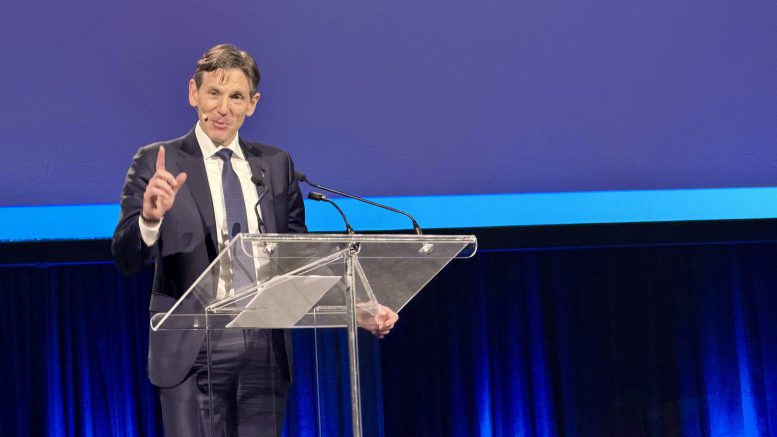
Canada risks losing the next wave of critical-minerals investment unless it tightens permitting timelines, builds shared infrastructure and backs strategic metals projects that private capital has struggled to underwrite, Teck Resources (TSX: TECK.A TECK.B; NYSE: TECK) CEO Jonathan Price said Monday.
Price’s remarks come as governments rewrite trade rules, supply chains creak and the electrification buildout accelerates faster than miners can add new supply.
“It’s a national competitiveness problem, not a corporate one,” Price said at CIM Connect’s opening plenary in Vancouver. “Demand moves in years, and supply moves in decades, pointing to the reality that new datacenters can spring up in nine months where mines take at least a decade to reach production.”
Price used the contrast to argue Canada needs to treat permitting certainty as economic policy. Predictable approvals are “the single biggest lever we can pull to unlock investment,” he said. Regulators, Indigenous governments and industry could compress timelines while keeping strong environmental and social standards, he added.
Monday’s opening session marked the 100th anniversary of the CIM Expo. Organizers expect about 7,000 attendees over the conference, more than 230 presentations, 19 panels and more than 600 exhibitors. The event runs from May 3 to 6.
Collaboration required
Another key constraint for Canada relates to infrastructure, Price said. Canada has the geology, but too often lacks the roads, transmission and ports to make deposits bankable.
Northwestern British Columbia — which Price described as rich in undeveloped mineral potential but hamstrung by a shortage of enabling infrastructure, and particularly power — is a case in point. Multi-user projects such as the proposed North Coast Transmission Line are to decide whether the region’s copper potential turns into production, he said.
Metals for which markets remain small, volatile or concentrated in a few refining hubs represent a third stumbling block, Price said. Germanium and gallium, along with rare earth elements, are inputs included in national critical minerals lists that matter to defence and advanced technologies but rarely offer investors the scale or pricing stability to justify the risk on their own.
“Public-private collaboration is the only way to responsibly expand the domestic capacity and secure those small but essential supply chains,” Price said.
Strategic industry
Price’s keynote carried a wider message: mining has moved from a cyclical story into a strategic one. Policy makers have started shifting from “just in time” supply chains to “just in case,” scrambling for “safe harbours” in stable jurisdictions since disruptions in one refining hub could ripple across energy technologies and defence manufacturing.
That urgency is linked to power demand. Global electricity use rose about 4% a year, Price said, and the world needs about 60 million km of new or replacement transmission lines by 2035. The buildout would devour copper and aluminium with electrification-driven copper demand expected to climb about half from 2025 to 2040. Artificial-intelligence data centres compound the problem because they consume disproportionally more copper than older facilities.
Capital follows jurisdictions that can permit, build and operate faster than competitors. Canada holds an advantage in stability and technical depth, Price said, but it still has to choose to lead. “Leadership is a choice,” he said.
Price pointed to Teck’s planned $53 billion merger with Anglo American (LSE: AAL) as evidence Canada can still win global mining capital because it anchors a new critical-minerals heavyweight with its headquarters in Vancouver, a “choice” he said “matters” as governments hunt “trusted suppliers.”
Mining’s moment
Canada’s biggest growth problem is not a lack of deposits, but the friction that keeps projects from becoming mines, a panel moderated by Rio Tinto’s (ASX, LSE: RIO) Technical Director for Mineral Resources, Strategy and Governnce Lucy Potter with Wheaton Precious Metals (TSX: WPM) chair Randy Smallwood, Lundin Group executive Adam Lundin and veteran director Catherine McLeod-Seltzer said.

Rio Tinto’s Lucy Potter (from the left) moderates CIM Connect’s opening-panel discussion with Teck Resources director Catherine McLeod-Seltzer, Lundin Group executive Adam Lundin Teck Resources CEO Jonathan Price and Wheaton Precious Metals chair Randy Smallwood in Vancouver. Credit: Henry Lazenby
Canada is “incredible” for resource wealth but “poor from an infrastructure perspective,” Smallwood said, arguing government could do more good by backing corridors that lower operating costs instead of trying to steer capital into specific projects. He urged operators to squeeze more metal from existing footprints once society has accepted a mine, because lower power costs and better recoveries can extend mine lives and curb the push to build new operations elsewhere.
McLeod-Seltzer drew a bright line around government’s role. Markets could fund strong projects, she said, if governments delivered permitting reliability and clear rules.
“That policy framework, that permitting reliability, matters more than governments trying to pick winners,” she said.
Price agreed the scale of infrastructure and processing decisions often demands collaboration between companies that compete on the ground.
Human constraints
Human constraints shouldn’t be overlooked, conference attendees were also told. Mining has undersold its purpose to young workers and risks losing them once they arrive, Price said.
“In many cases, it’s retention that’s a harder challenge right now than recruitment,” he said.
Be the first to comment on "CIM Connect: Teck chief pushes permits, power lines as Canada’s mining bottlenecks"