
China’s steel consumption is projected to decline steadily over the next decade, marking a structural shift in global demand dynamics, according to a new report from Wood Mackenzie.
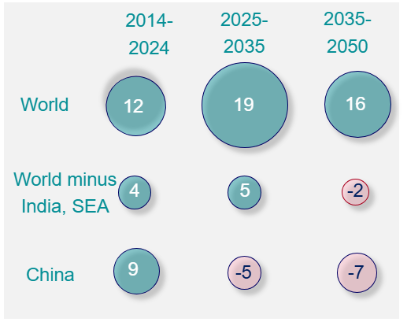
The country is expected to need an average of 5 million to 7 million tonnes annually, pushing its share of global steel consumption down from 49% in 2024 to just 31% by 2050, according to the Edinburgh-based energy and mining consultancy. Expressed in relative terms, the 18 percentage-point cut represents roughly a 36% decline in its share of global demand.
Meanwhile, India, Southeast Asia, and the Middle East and North Africa (MENA) are emerging as strategic growth hubs, reshaping both demand and supply chains across the steel industry.
China’s decline
The deceleration in Chinese steel demand reflects the economy’s pivot away from infrastructure-heavy growth. Real estate development, a key driver of steel consumption, faces prolonged weakness, while construction activity remains subdued as policymakers prioritize economic rebalancing.
“China’s overcapacity crisis is reaching unprecedented levels, with an expected surplus of 50 million tonnes in 2025 that could balloon to over 350 million tonnes long-term,” Wood Mackenzie principal analyst Rohan Trivedi said in the report.
Despite expected production cuts of up to 240 million tonnes between 2024 and 2050, China’s vast industrial base ensures the country will remain a dominant force in global supply dynamics.
In contrast, India is consolidating its role as a steel demand powerhouse. After an 8% jump in 2024, demand is set to grow another 7% in this year, underpinned by government-led infrastructure projects, urban development and manufacturing expansion. Wood Mackenzie expects India’s steel demand to grow at a compound annual rate (CAGR) of 4% to 5% through 2050, tripling its share of global demand from 8% today to 21% by mid-century.
Southeast Asia is also on a strong growth trajectory, with 6% demand growth in 2024 and a projected 3–4% CAGR through 2050.
Average annual steel demand, Mt
The region’s demand share is set to double from 5% to 10% by 2050, led by Vietnam, Thailand and Indonesia, as they expand industrial capacity and capitalize on cost advantages relative to developed economies.
Global realignment
Global crude steel production is forecast to expand at a modest 0.7% CAGR through 2050, with developed economies experiencing flat or declining output.
India is on track to nearly triple production, cementing its place as the world’s second-largest producer by 2050. Its steelmakers benefit from ample iron ore resources, modernizing mills and robust domestic demand. Southeast Asia, meanwhile, is rapidly scaling up capacity – often with electric arc furnace technology – to serve both domestic and export markets.
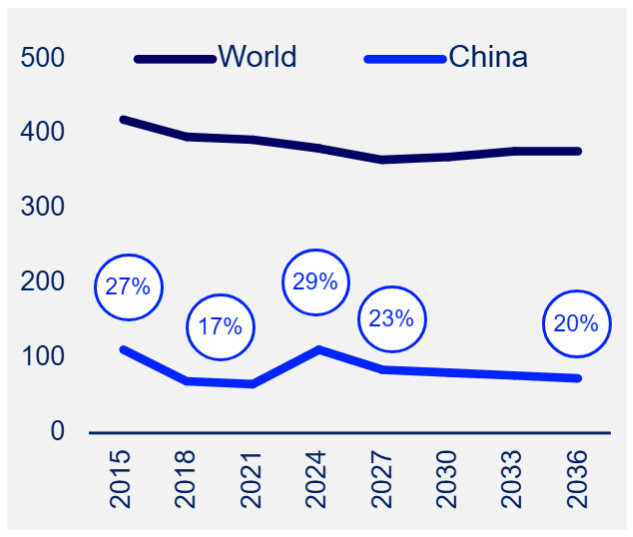
Annual steel trade, Mt
While China maintains the top spot in global production, it faces structural overcapacity and increasing pressure to consolidate and modernize its aging blast furnace fleet, according to the report.
Long-term, global exports are expected to fall to just 12% of crude steel production, down from today’s 25%, as regionalized supply chains take shape. Future adoption of carbon border taxes is also likely to further disadvantage emission-intensive producers.
Be the first to comment on "China’s steel demand share to plunge 36% by 2050"