
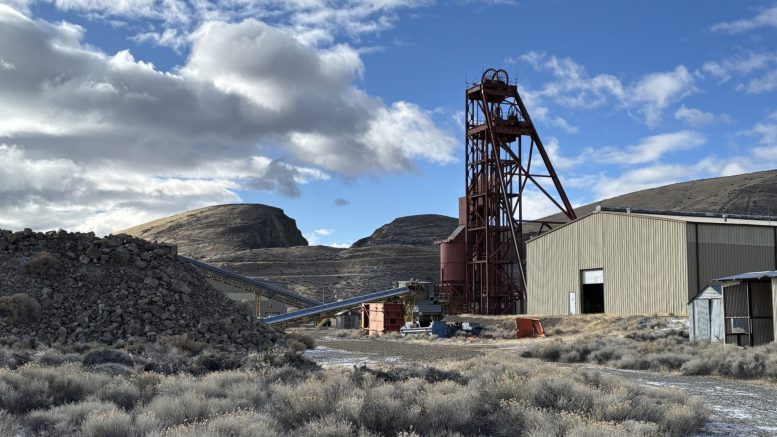
Blue Moon Metals (TSXV: MOON; Nasdaq: BMM) has acquired a set of 33 tungsten and antimony projects in the western U.S., including projects near its Springer complex, among the very few tungsten processing plants in North America.
The deal will see the private owner of the projects on BLM and Forest Service lands receive 2.8 million common shares in Blue Moon for about $15.5 million, a 1% net smelter return royalty on each project and around $5 million in cash, Blue Moon reported Tuesday.
“This acquisition marks a meaningful step in Blue Moon’s strategy to build a leading U.S.-focused critical metals platform,” Jason Dunning, the company’s head of U.S. Special Projects said in a press release. “Many of these projects historically produced high-grade antimony and tungsten” during periods of major demand such as World War I, World War II, the Korean War and the Vietnam War, he said.
Critical metals push
The acquisition deepens Blue Moon’s exposure to two metals that have become strategic priorities for the U.S. as Washington seeks to rebuild domestic critical mineral supply chains and secure metals outside of Beijing’s influence.
Tungsten is a critical metal that has the highest melting point of any metal, and extreme density, making it essential for heavy industry, aerospace engineering, advanced electronics, and military defence systems like armour-piercing ammunition.
Tungsten production in the U.S. ceased in 2015 as mining was no longer commercially viable due to low prices and competition from China. Beijing now dominates global tungsten production, accounting for over 80% of last year’s total output of 81,000 tons, according to the United States Geological Survey (USGS).
Top four
The portfolio deal comes with a holding cost of around $162,000 per year, Blue Moon said.
Blue Moon highlighted four of the newly acquired properties as candidates for direct shipping of high-grade tungsten to Springer, which is located in northwestern Nevada.
They include the Oregon mine in Colorado, which produced 5,000 tons grading 14.51% tungsten trioxide (WO3) between 1907 and 1929, Blue Moon said, citing the USGS; and the Wildhorse Canyon mine in Idaho that produced about 7,461 tons at 0.62% WO3 in the 1950s.
First foray
The deal also marks Blue Moon’s entry into antimony. It also brings into its portfolio five historical high-grade projects hosting grades of 2-10% stibnite.
Antimony is used in defence applications such as flame retardant fabrics, communication equipment, night vision goggles, ammunition hardening and laser sighting. The U.S. has no mined production of antimony and relies on foreign suppliers such as China.
United States Antimony’s (NYSE: UAMY) Thompson Falls plant in Montana is currently the only antimony smelter in the country. The company also holds the only other smelter in North America: the Madero plant in Mexico.
Blue Moon shares fell 2% to C$7.52 apiece on Tuesday morning in Toronto, for a market capitalization of C$769 million. The stock has traded in a 12-month range of C$2.96 to C$11.80.


Be the first to comment on "Blue Moon adds tungsten, antimony projects for $20.5M"