
Sometimes two problems, when put together, can create a solution. This article describes one such case, regarding the needs of the resource industries and those of First Nations communities.
Many members of Canada’s mining sector are looking for better ways to meet environmental regulations, particularly regarding monitoring and verification. These regulations require ongoing assessment of the work’s impact on the natural environment, including its soil, plants, wildlife and water courses.
In many cases, the long-term containment assessment requirements pose challenges, because it is difficult to find employees willing to build long-term careers in isolated parts of the country.
In addition to the need to pay high salaries and benefits, there are significant rates of turnover. Problems such as these can mean that what might have been a promising orebody remains underground.
At the same time, the First Nations communities in Canada’s North are facing their own problems. Some members are concerned that the work being done by the resource companies be done in a way that meets traditional respect for the land and all it contains.
First Nations people are also faced with a lack of employment and career prospects. This means that to build a viable career, many of the best and brightest must move away from their communities. It is not news that many First Nations communities face significant poverty and related social problems. Leaders feel a need to create sustainable training, education and employment opportunities for their people.
About three years ago, Golder Associates decided to put these needs together in a way that would meet some of the needs of the resource industries and of the First Nations communities, and in the process, benefit the natural environment.
Golder’s work with the mining sector often involves third-party assessment of environmental effects and ongoing monitoring of those effects. Some of this work must be done by professionals with years of training and study at the doctoral level, such as fully qualified biologists.
However, Golder also realized that much of the work can be done by individuals with much less training. It is this “biologist’s assistant” type of position that is both essential to the success of the environmental work and accessible to individuals with only elementary or high school experience.
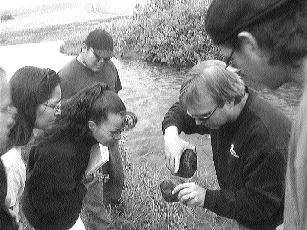
Now, trained and qualified First Nations people play a key role in monitoring the environmental effects of mining, helping companies fulfil regulatory requirements.
This initiative also offers a way out of the traditional “chequebook diplomacy” in which resource companies have used grants and donations to improve relations with First Nations. These gestures have often been seen as self-serving tokenism, resulting in little ongoing benefit.
Success factors
For companies interested in working more closely with First Nations entities on environmental assessment work, here are some suggestions based on Golder’s experience.
— Meet a real need — One of Golder’s first steps was to determine the needs faced by companies in the resource sector regarding the environment. For example: meeting regulatory requirements to minimize environmental impact, returning the land as close as possible to its original state when operations are finished, and verifying that reclamation has been done. There is also ongoing monitoring of the effectiveness of the remediation work, particularly for tailings dams.
— Accredited training program — Golder developed a catalogue of skills needed to meet these needs. This led to a training method, curriculum, courses, and a program accredited through the Engineering Institute of Canada and authorized by the International Association for Continuing Education and Training. Golder achieved this through a training branch of the firm called The Golder Institute. Demonstrating accreditation of the program is essential to making sure that the work done by employees complies with regulations.
— Portability of skills — Employees need to be able to develop their careers, and that means demonstrating their qualifications to other employers. The “passport of skills” approach facilitates this. The certificates, or “passports,” of the program’s graduates indicate the work for which they are qualified.
— Build involvement of First Nations entities — In developing its program, Golder turned to longstanding entities in First Nations communities to develop separate companies to handle the environmental work. Some of these companies are wholly owned by First Nations; others are joint ventures. Due diligence is key, because some First Nations entities are accustomed to working with grants and donations (as opposed to more entrepreneurial companies).
— Provide support — On a technical level, Golder has found that while many First Nations groups have information technology and accounting systems adequate for their needs, these systems may need upgrading to be acceptable for environmental work. Also, some of the accounting and record-keeping requirements of regulatory bodies are highly specific, and training may be required.
On a business level, Golder has provided coaching support in several areas — for example, how to provide a bid on part of a project if the whole job would be too much for the company to handle on its own. In some cases, we needed to provide “how-to-work” training for individuals with little or no experience in the wage economy.
Success story
One example of the success of this concept is Siksika Environmental, a company Golder helped develop. Siksika Environmental is now wholly owned by Siksika Nation, whose land is 100 km east of Calgary, Alta. It provides environmental services to a wide range of resource companies, some of which have activities on Siksika land.
Head Chief Strater Crowfoot says the company’s most significant impact has been an increase in the knowledge and awareness of the environment among the Nation’s people, and the ability to pass this on to the next generation. He is also confident that because of the involvement of the Nation’s members in the company, the resource work on Siksika land is being carried out responsibly and respectfully. And he is pleased with the work skills the Nation’s members are learning, and with the economic impact of the company.
Companies such as Siksika Environmental provide a model that can be used in many parts of the world where resource companies work in remote areas and where the inhabitants want a better life.
— The author is responsible for community and corporate affairs relating to First Nation business development, as well as training, on behalf of Golder Associates. He is based in the firm’s office in Calgary and can be reached by e-mail at lveilleux@golder.com
Be the first to comment on "Better outcome for mining sector and First Nations"