
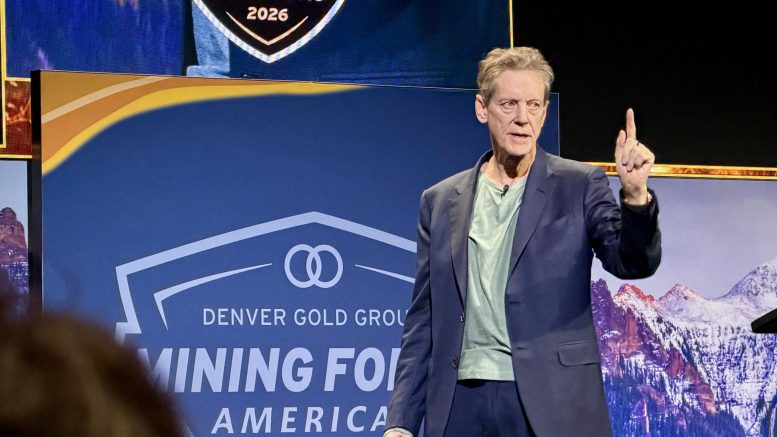
Colorado Springs, Colo. – Robert Friedland wants to replace mining’s power-hungry grinding mills with short bursts of electricity that shatter ore from the inside.
The Ivanhoe Mines (TSX: IVN; US-OTC: IVPAF) founder and executive co-chairman told Mining Forum Americas on Monday that technology developed by his private company, I-Pulse, could use up to 80% less energy than conventional grinding and increase metal recoveries by about 5%. Those are I-Pulse’s projections for the technology.
“What we want to do is take away that SAG mill and that ball mill – bye-bye,” Friedland told the conference in Colorado Springs. “It’s a huge savings in electricity and a much lower carbon footprint.”
If I-Pulse can deliver those gains at commercial scale, the technology could cut one of mining’s largest operating costs while helping companies extract more metal from lower-grade ore. The challenge is turning promising tests into equipment that can process thousands of tonnes of rock around the clock and compete with mills miners have relied on for decades.
Inside out
Mines generally crush and grind ore from the outside using steel, gravity and brute force. Semi-autogenous grinding, or SAG, mills tumble ore, sometimes with steel balls, before ball mills reduce it further for mineral recovery.
Grinding is an enormous power draw. A U.S. Energy Department study identified it as the largest energy-consuming process in the U.S. mining industry. The department’s figures describe industry-wide energy use, however, and aren’t a measure of potential savings at an individual mine.
I-Pulse subsidiary I-ROX takes a different approach. Its system stores electricity and releases it in pulses lasting from billionths to millionths of a second. The resulting shock waves pass through the ore and fracture it from within, preferentially breaking along mineral boundaries, I-ROX says.
That could expose more valuable minerals and produce fewer ultrafine particles than conventional grinding. I-ROX says the process could lower energy use while improving recovery, although it hasn’t published commercial mine-scale results supporting its headline claims.
Efficiency reinvented
Near the end of a presentation that ricocheted from flying saucers and artificial intelligence to China and “particularly frightening” military robotic dogs, Friedland, 76, played footage of copper ore falling through an I-ROX test unit and disintegrating under electrical pulses.
“We’re able to take these large pieces of rock down to a very fine powder, but we do so very efficiently,” he said.
Higher recoveries could let miners produce more metal from the same tonnes, extend mine lives and improve the economics of marginal deposits. Lower power demand could also shrink the generating capacity required for new mines as operators pursue deeper, harder and lower-grade orebodies.
Scale test
Ivanhoe has more than Friedland’s showmanship riding on the technology. In 2023, the miner converted a US$76-million loan to High Power Exploration into an equity stake in I-Pulse.
Ivanhoe also sent ore and tailings from its Kamoa-Kakula copper complex in the Democratic Republic of Congo to I-ROX’s research centre in Toulouse, France, for tests targeting lower energy use and higher recoveries. Friedland didn’t disclose the results during his keynote.
Founded in 2022, I-ROX opened a research centre in Toulouse in January 2025 with 2,500 square metres of shop floor for larger experiments and demonstrations. I-Pulse also secured a $250-million award from the U.S. Department of Commerce under the CHIPS Act to develop silicon-carbide semiconductors.
Geothermal drilling
The same pulsed-power platform underpins G-Pulse, which uses electrical bursts to weaken hard rock ahead of a conventional drill bit.
Friedland said the tool drills about three times faster and extends bit life sixfold, although I-Pulse hasn’t published independent results supporting those claims.
The company plans to validate G-Pulse at the Millungera Basin geothermal project in northwestern Queensland. Under its partnership agreement, I-Pulse is to take operational control and earn an initial 80% interest by investing at least $5 million. Its stake would become 65% when the joint venture is formed.
“The core technology we need to crush and grind rock and drill is the same technology we need to go geothermal,” Friedland said.
Not yet
Friedland didn’t say what an industrial I-ROX or G-Pulse unit would cost, how much ore it could process or when one might operate continuously at a mine. He also didn’t present independently verified results comparing I-ROX with a conventional grinding circuit.
Those gaps leave the SAG mill securely employed. Still, Friedland put a fresh spin on his familiar copper-scarcity warning: as the industry confronts a projected 2040 supply gap equal to almost eight Escondidas, better processing could recover more metal from ore miners already handle.
Addressing mining companies outside I-Pulse’s shareholder group, Friedland was blunter.
“Those of you that are not on that list, I will give you a crying towel,” he said. “You’re toast. You won’t be able to do this the old-fashioned way.”
Be the first to comment on "Mining Forum: Friedland wants to kill the SAG mill"