
SuperCritical Materials has partnered with the University of Michigan to test whether technology for extracting uranium from seawater can withstand the mechanical demands of industrial-scale marine deployment.
The research will focus on systems for deploying and retrieving large quantities of SuperCritical’s uranium-selective adsorbent, including how the material responds to packing, waves, currents and repeated operating cycles. Testing is expected at the university’s Aaron Friedman Marine Hydrodynamics Laboratory.
“The question is no longer simply whether uranium can be extracted from seawater,” SuperCritical President and CEO Alexander Canon Bryan said in a release this week. “The question is whether the adsorbent can be deployed, exposed and retrieved efficiently and repeatedly at industrial scale.”
The work addresses one of the main obstacles facing efforts to turn the oceans into a commercially viable uranium source. Seawater contains an estimated 4.5 billion tonnes of dissolved uranium, but at extremely low concentrations, requiring vast quantities of water to come into contact with recovery material.
Exclusive licence
Austin, Texas-based SuperCritical secured in July an exclusive licence to commercialize uranium adsorbent technology originally developed by the U.S. Department of Energy’s Pacific Northwest National Laboratory and research partners. The Northern Miner examined the broader push to recover uranium from seawater in a March feature.
The technology uses an adsorbent that captures dissolved uranium as seawater passes across its surface. The material is later retrieved and processed to recover the uranium before being prepared for another deployment cycle.
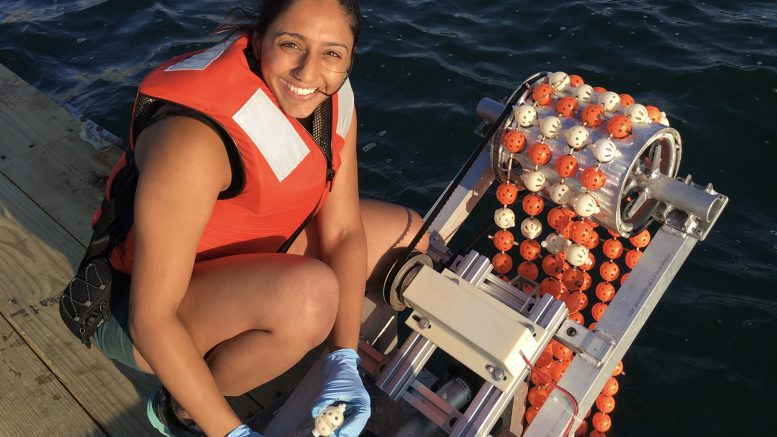
Researchers at Michigan will mechanically characterize the adsorbent, evaluate different packing configurations and design and build prototypes for deploying and retrieving it. Those systems will then undergo hydrodynamic testing under simulated marine conditions.
“Extracting critical materials from the ocean requires more than a high-performing absorbent,” said research lead Maha Haji, an assistant professor of mechanical engineering at the University of Michigan. “It requires an offshore system that can operate efficiently, reliably and responsibly under demanding marine conditions.”
MIT background
Haji previously worked on concepts for deploying uranium adsorbents while at the Massachusetts Institute of Technology. Her doctoral research included designing, building and ocean-testing systems intended to recover uranium from seawater.
The Michigan program is expected to progress from mechanical testing and prototype development towards designs that could be used in future offshore pilot deployments. Results are also intended to feed into operating and capital-cost modelling and a subsequent feasibility study.
SuperCritical is pursuing the technology as the U.S. seeks to expand domestic nuclear-fuel supply and reduce reliance on imported uranium. The company says its nearshore development program is aimed at determining whether seawater extraction can ultimately operate at commercially competitive scale.
Be the first to comment on "SuperCritical tests seawater uranium system"