

The Netherlands’ central bank has transferred 86 tonnes of gold from North America to London, cutting the share of its bullion held in New York to 19% from 31% as it seeks faster access to reserves during a potential crisis.
De Nederlandsche Bank, or DNB, said on Wednesday that it sold about 59 tonnes held in New York and bought an equivalent amount of London Good Delivery-standard gold. More than 27 tonnes was physically moved from the U.S. and Canada to the Netherlands, while a similar amount of tradeable bullion was transferred from the Netherlands to London.
“With this relocation, we have improved the tradability of our gold reserves,” DNB Governor Olaf Sleijpen said in a release. “We expect that we will never need to use them, but we do need to strengthen our resilience and preparedness.”
John Plassard, an analyst at Geneva-based Cité Gestion Private Bank called the Dutch decision a “fairly one-off move” in remarks to AFP, but said widespread shifts by other central banks could hurt confidence in the U.S.
Location, location
The repositioning is notable because it changes where a major Western central bank wants its gold available in an emergency rather than how much gold it owns. DNB didn’t say it had lost confidence in either the U.S. or Canada, but the move comes amid growing debate in Europe over the location of national gold reserves.
In April, Bank of France pulled its remaining gold stored in New York and replaced it with a similar amount in Paris. Germany’s Bundesbank has faced calls to repatriate some of the roughly one-third of its bullion stored in New York.
The move leaves the Netherlands’ total gold holdings unchanged at 612.4 tonnes. London now holds the largest share at 32%, up from 18%, while 31% remains at DNB’s cash centre in Zeist. New York and Ottawa each hold 19%. The reserves were worth €72.2 billion (US$83.6 billion) at the end of 2025.
‘Unrest’
DNB said “increasing geopolitical unrest” prompted it to strengthen its crisis preparedness and spread risk more evenly between North America, Britain and the Netherlands. Gold held at the Bank of England meets international trading standards and can be deployed more quickly than bullion stored in New York or Ottawa, it said.
Germany has the world’s second-largest gold reserves, and keeps a large portion — about a third estimated at around 1,200 tonnes — in the New York Federal Reserve’s vaults in Manhattan. The Bundesbank said this year that the location “is and remains an important storage site for our gold.”
France, one of the world’s leading gold holders, had been storing 129 tonnes, or about 5% of the bank’s total holdings, with Federal Reserve Bank of New York, a practice it began in the late 1920s. It first began repatriating the gold in the 1960s.
The decision to keep the new bars in Paris is “not politically motivated,” as the higher-standard gold bars it bought were traded on a European market, BdF Governor Francois Villeroy de Galhau said in a release.
Central bank buying
The Dutch reshuffle comes as central banks continue to accumulate bullion amid geopolitical and economic uncertainty. Official-sector net purchases reached 289 tonnes in the second quarter, a record for that quarter, according to the World Gold Council. Reported buying added another 23 tonnes in July, led by China and Poland.
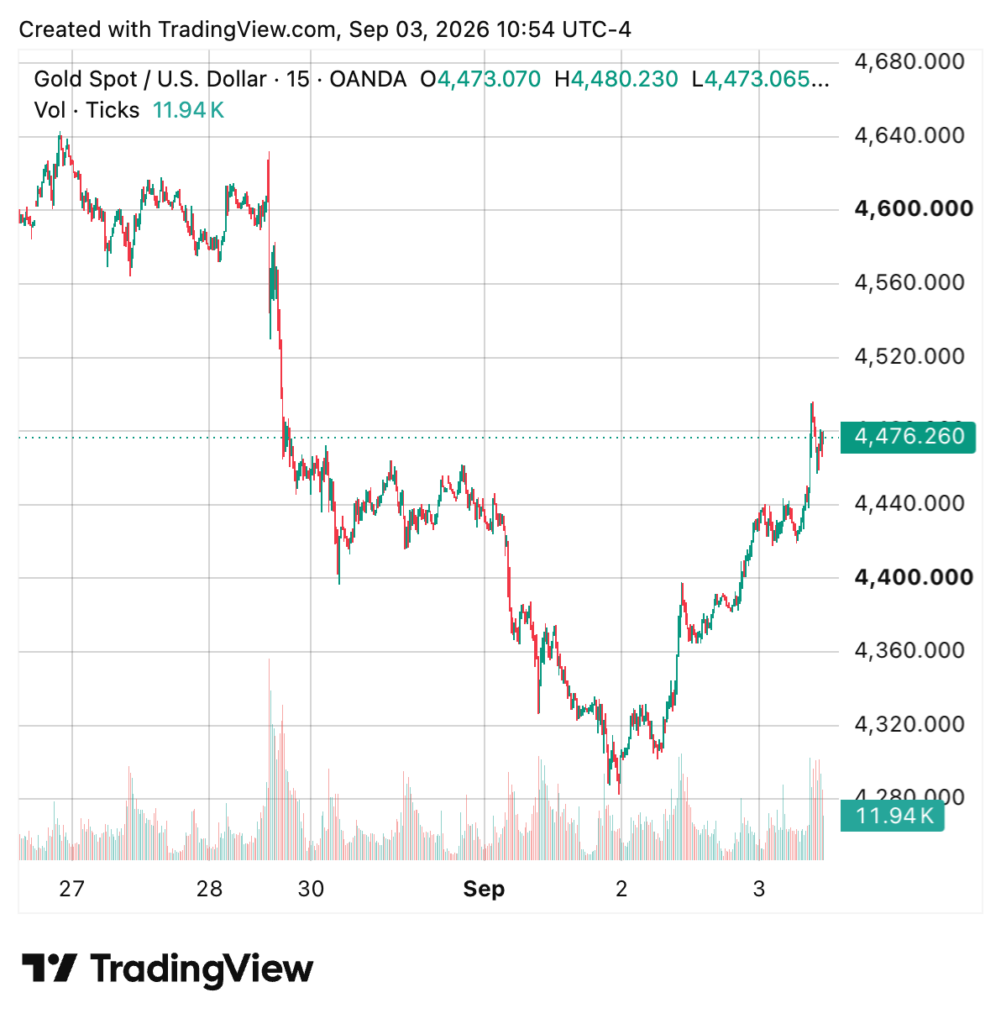
Gold was trading above $4,475 per oz. on Thursday as a weaker U.S. dollar and lower Treasury yields lifted the metal. Spot gold has gained 2% during the session.
China
At the same time, China is building infrastructure intended to draw more bullion trading and price discovery towards Asia.
Hong Kong launched a central gold clearing system in July and is developing yuan-denominated futures and a physical-delivery link with the Shanghai Gold Exchange as it seeks to expand vault capacity to more than 2,000 tonnes by 2030.
The Chinese initiative is moving in a different geographical direction from the Dutch decision, but both highlight an increasingly important question for reserve managers: not simply whether to own gold, but where the metal is held and how quickly it can be mobilized.
Be the first to comment on "Dutch slash New York gold in crisis shift"