
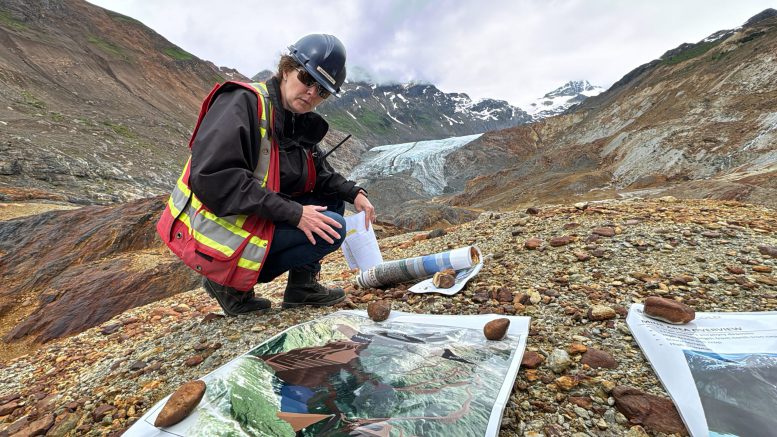
Canada still discovers giant gold deposits faster than it builds them and Seabridge Gold’s (TSX: SEA; NYSE: SA) KSM project in British Columbia’s Golden Triangle is one of them.
KSM won provincial and federal environmental approvals in 2014. Twelve years later the $8.8-billion (US$$6.4-billion) capex development remains unbuilt despite hosting proven and probable reserves of 2.29 billion tonnes grading 0.64 gram gold per tonne and 0.14% copper for 47.3 million oz. gold and 7.3 billion lb. copper.
The latest development snag involves a tunnel route. The province last month indefinitely delayed a decision on permit amendments required for KSM’s Mitchell Treaty Tunnels because about 12.5 km of the route crosses mineral claims held by Tudor Gold (TSXV: TUD) on its early-stage Treaty Creek project.
Seabridge and Tudor must sort out the tunnel issue first, B.C. says, though no court date has been set. That was even after the province named KSM a priority project on April 30 and promised dedicated permitting coordination.
“The most significant challenge in recent years has been provincial permitting timelines,” Rudi Fronk, Seabridge’s chair and CEO, told The Northern Miner. “Inconsistent provincial handling of Indigenous consultation added complexity and delay.”
Gauntlet
In Canada, and particularly B.C., miners can still find large deposits despite a global slowdown (See page 6) but they struggle to move them through rights conflicts, consultation, infrastructure deficits and shifting approval goal posts.
Yet in the past 19 months or so since Jagrup Brar was appointed B.C.’s Mining and Critical Minerals Minister, the province has gained permitting momentum. Six major mine permits were issued in the past 12 months alone, including Eskay Creek, Mt. Milligan, Copper Mountain’s New Ingerbelle expansion, Dome Mountain, the Quintette restart and Highland Valley Copper’s extension.
Eskay Creek is perhaps the most relevant example, showing the permitting of projects (albeit brownfields) in the Golden Triangle, a remote northwestern B.C. district that hosts some of Canada’s richest gold and copper deposits, can get done.
Skeena Resources (TSX, NYSE: SKE) earned its final permit in early February and said the project was half-completed that month with first production slated for the second quarter of next year.
Cost of delay
The cost of permitting delays is now easier to measure. A Mansfield Consulting study prepared last month for the Mining Association of B.C. (MABC) estimated the province’s 18 operating mines and two smelters generated $27.8 billion in economic output, $17.1 billion in gross domestic product and 56,237 jobs in 2024.
One average new mine adds $2.6 billion in output during development and $27.7 billion over operations, according to the study.
B.C.’s mining sector has regained momentum after years of drift, Michael Goehring, President and CEO of the MABC, said in his May 5 annual address to the Greater Vancouver Board of Trade. But that progress will not last unless the province moves faster and gives investors more certainty.
“Certainty attracts investment,” Goehring said. “Investment builds projects and projects build prosperity.”
BC’s two-step
The province has put selected projects on a faster track and amended the Environmental Assessment Act to push issue resolution with First Nations earlier in the process and exclude U.S. tribes from “participating Indigenous nation” status.
At the same time, miners are still digesting December’s Appeals Court ruling known as the Gitxaała case. It said B.C. must amend its claims process to give First Nations consultation rights through the province’s Declaration on the Rights of Indigenous Peoples Act (DRIPA). It positions DRIPA as an immediate source of legal risk for project developers.
Victoria first said it would suspend or amend DRIPA during the spring session, then backtracked and put any plans on hold.
National review
New co-operation agreements between Ottawa and the provinces for less duplication in federal reviews are beginning to improve timelines without weakening environmental oversight, Mining Association of Canada President and CEO Pierre Gratton said.
He also pointed to Ottawa’s May 8 discussion paper, Getting Major Projects Built in Canada, which proposes one-year federal review timelines, a single federal decision, a Crown Consultation Hub and ministerial approval for some post-assessment permits that now go to Cabinet.
Prime Minister Mark Carney also wants to ease federal decisions on using fish-bearing waters as tailings impoundment areas and Navigable Waters Act permits. Currently, both require Governor in Council and full cabinet approval.
“The government has proposed changing these to ministerial approvals,” Gratton told The Northern Miner in an email exchange. “They are not always required, but when they are they can add years to timelines. If so, this will shave months, if not years, off the timelines for these permits.”
Open-ended
Back at KSM, Seabridge has invested $1.2 billion to advance the project, including more than $650 million since 2021 on roads, camps, a switching station, a bridge and fish habitat compensation sites, according to CEO Fronk. Seabridge expects to spend another $190 million this year and employ about 400 people. Fronk continues his search for a capable project development partner.
At Treaty Creek, Tudor says the tunnels should be rerouted to avoid its deposits. The uncertainty is hurting the company’s valuation and dilution, Tudor President and CEO Joseph Ovsenek says. Predictable permitting, clear land access and workable infrastructure must be addressed.
“Unless you can confidently tick all those boxes, the ounces will stay in the ground,” Ovsenek told The Northern Miner by email.
“We are confident in our legal position and the dispute does not impact the timing or trajectory of Treaty Creek’s advance in any case (at this stage),” Ovsenek said. “So we are moving forward with development plans assuming no impact from the tunnels.”
In February, Tudor launched a preliminary economic assessment aimed at an underground start on higher-grade zones within the Goldstorm deposit. It hosts 912.3 million indicated tonnes grading 0.85 gram gold, 5.07 grams silver and 0.15% copper for 24.9 million oz. gold.
For proponents, the process has to be clear and predictable.
“A jurisdiction that can’t promise that can’t call itself ‘tier one’,” Tudor’s Ovsenek said. “Canada’s provincial and federal governments can talk about being mining friendly or promoting critical minerals, but the most critical projects of all are those that can actually get built to deliver the promised benefits.”
Be the first to comment on "KSM shows how difficult it is to build a mine in Canada "