
Rollingdam, N.B. — The majors are sitting up and taking notice of a brand-new gold discovery made by
Since encountering a broad intercept of high-grade gold mineralization in a first pass of drilling, the junior has been inundated by requests from major companies wanting to have a look at this virgin discovery, which had never previously seen a drill. The Clarence Stream property lies 70 km southwest of Fredericton, the provincial capital, in an area of New Brunswick best known for tungsten and tin mineralization. The past-producing Mount Pleasant tungsten-molybdenum mine is just 8 km to the east.
Freewest ended a first round of shallow drilling in April after completing 3,474 metres in 39 holes. The drilling targeted multiple zones of gold-bearing mineralization that had been intermittently exposed by trenching over a collective strike length of 2 km. Mineralization is hosted in brittle-to-ductile shear zones, healed by quartz veins and flooding, within metasedimentary and gabbroic rocks of the contact aureole of the St. George batholith, a large, 2,000-sq.-km, high-level granitic intrusive. The quartz-vein mineralization strikes northeast-southwest and is aligned roughly parallel to the northwestern contact of the St. George batholith.
The metamorphic contact halo emanates outward from the St. George batholith for at least 1 km into flanking metasediments and metagabbros of the Kendall Mountain formation. Rock types include variably silicified, hornfelsic metasediments, plus biotite, calc-silicate, amphibole-rich hornfels and metagabbros.
While testing the Central zone area of the property, Freewest intersected 21 metres averaging 15.06 grams gold per tonne at a vertical depth of 60 metres below surface in hole 39. The intercept included higher-grade sections of 18.67 grams over 1 metre, 130 grams over 1 metre, 69 grams over 0.5 metre and 147 grams over half a metre.
Hole 39 had undercut hole 37, which pulled 27.5 metres grading 3.5 grams, including 14.5 metres of 5.3 grams, at 30 metres of depth. Both holes encountered strong quartz veining and stockwork hosted in highly siliceous and sericitically altered quartzwacke and hornfel.
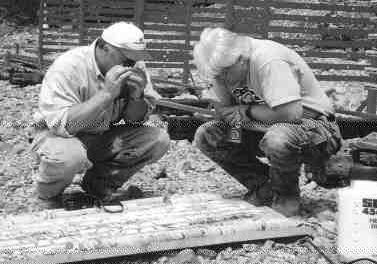
Freewest resumed drilling at Clarence Stream in early June. The first 10 holes from the second round further tested the Central zone at 25-metre increments over a strike length of 75 metres and to a vertical depth of 90 metres. During a recent site visit, Project Manager George Murphy told The Northern Miner that all but one of the holes had hit visible gold in the upper part of the zone.
Hole 40 was drilled along the same section (L8+50E) as holes 37 and 39, undercutting the two holes to 90 metres of depth. Hole 40 intersected 12.5 metres averaging 6.64 grams, including 2 metres of 18.82 grams plus 0.5 metre of 17.22 grams. Freewest plans to step-back from hole 40 and undercut the zone by another 25-30 metres of depth with hole 53.
Holes 42, 41 and 47 tested section L8+25E by stepping out 25 metres to the west. Hole 42 cut 12 metres averaging 7.21 grams (including 1 metre of 33.46 grams and half a metre of 22.66 grams) at 25 metres of depth. Hole 41 hit the zone at 50 metres of depth, returning 14.9 metres of 7.8 grams, including 1 metre of 33.63 grams. Hole 47 encountered 9 metres averaging 3.91 grams at about 90 metres of vertical depth.
Continuing 25 metres to the west, on section L8+00E, previously reported hole 38 from the first round hit 5.5 metres averaging 3.84 grams, including half a metre of 16.58 grams, at 60 metres of depth. Freewest intercepted the zone above and below hole 38 with hole 48 and 49, results from which are pending.
Going to the east, holes 44, 43 and 46 tested section L8+75E. Hole 44 cut the zone 25 metres below surface, yielding 9.5 metres averaging 21.51 grams (including 2.5 metres of 63.97 grams). At 50 metres of depth, hole 43 intersected 12 metres averaging 7.08 grams, including 3.5 metres of 14.42 grams and half a metre of 10.75 grams. Hole 46 pulled 9 metres averaging 5.45 grams from a vertical depth of about 90 metres.
A further 25 metres to the east, on section L9+00E, previously reported hole 14 encountered a series of narrow intercepts at 25 metres of depth, including 1.1 metres of 22.14 grams and half a metre of 4.9 grams. Hole 45 undercut hole 14 at 50 metres of depth and hit 8.5 metres of low-grade mineralization grading 0.39 gram, followed further down-hole by 9 metres grading 0.68 gram.
All samples are being split and fire-assayed, followed by screen metallic assays on samples from within the zone. “To date, [fire] assays that come back show high values in the metallics, so everything looks pretty consistent,” says Geological Consultant Glenn Lutes. The coarsest gold seen to date is about 1 mm in size. Most of the visible gold is half a millimetre or less, says Lutes.
Gold in the Central zone occurs in sheeted quartz veins and quartz vein stockwork, as well as heavily disseminated sulphide zones peripheral to the quartz veining. The zone of mineralization occurs in a sheared contact between predominantly gabbro sills and metasedimentary rocks. Biotite alteration also seems an important marker for some of the better grades.
Lutes says the metasediments are overturned and dip to the north at 65. They comprise a mix of Upper Silurian thinly bedded argillite soapstone, which was metamorphosed to muscovite-biotite-cordierite grade. Interbedded are some felsic tuffs. Most of the sequence is bedded, though some of it is chaotic. In addition, Lutes is starting to recognize some micro-granites.
There are multiple gabbro sills that, in plan, are fairly irregular. On section, the gabbros are always parallel to bedding and structure. Structural studies to date indicate two stages of deformation.
Mineralization consists of stibnite, aurostibnite, berthierite, gudmundite (iron-antimony sulphides), native antimony, native bismuth, native gold, arsenopyrite, sphalerite, pyrrhotite, pyrite and chalcopyrite. The pathfinder minerals for gold seem to be stibnite and arsenopyrite.
Drilling is continuing at the Central zone, which remains open along strike and to depth, with the aim of quantifying a gold resource. In addition, some footage of the second-round program has been allotted to test the East zone, 700 metres east of the Central zone.
The East zone was tested at a shallow depth over a strike length of close to 600 metres by 12 holes during the first pass of drilling. Several narrow, high-grade intercepts were reported. The zone consists of discrete quartz vein and replacement mineralization developed in a series of ductile shear zones hosted in biotite-cordierite hornfels.
Freewest optioned a 100% interest in the Clarence Stream property from local prospector Reginald Cox in May 1999 for $200,000 cash and 100,000 shares, to be paid over four years. Cox had discovered gold-bearing boulders while prospecting along newly built forestry roads. Grabs from the boulders assayed as high as 45.6 grams and carried arsenic and antimony.
When representatives of Freewest first walked the property, they collected 23 grab samples from float and subcropping material along a 1-km trend. These samples carried gold values ranging from 0.09 to 76.8 grams, for an average of 13 grams.
With no exposed outcrop to speak of, Murphy managed to find one small outcrop of gabbro in the Central zone area, where a narrow shear zone ran 2 grams.
The property is readily accessible from a network of provincial roads from all points in southwestern New Brunswick. Bisecting the property is a major powerline servicing the Mount Pleasant mine and the neighbouring village of Rollingdam.
In the summer of 1999, Freewest began a program of line-cutting, prospecting, geological mapping and soil-sampling, as well as induced-polarization and magnetic geophysics. Additional sites of highly-anomalous-to-bonanza-grade mineralized float and subcrop were subsequently discovered. Several extensive gold-arsenic-antimony soil a
nomalies were found to coincide with the float and subcrop.
Late in 1999, Freewest began trenching, which continued on through 2000 at several locales. Trenching exposed a series of sheeted parallel quartz veins. Two zones in particular yielded significant high-grade gold values, namely the West and East showings.
Freewest completed additional soil sampling last fall, collecting about 2,000 samples on an expanded grid. The company defined gold-arsenic-antimony anomalies that rival those overlying the East and West zones. Line-cutting has begun on one particular anomaly, a large crescent-shaped gold-in-till anomaly north and west of the current area of focus. The line-cutting will be followed by soil-sampling, prospecting, mapping and trenching.
Freewest recently tied up a lot more land in the Clarence Stream area, picking up a further 36.5 sq. km to hold a total of 94.1 sq. km. Several junior companies and individuals have picked up ground in the immediate area of Freewest, including
Be the first to comment on "NB gold project generates interest"